
7-iron
Golf Club Iron 7: Loft, Distance and How to Use It
Sandy Grewal · 6 October 2026
Table of Contents

A golf club iron 7 isn't a universal distance club. The number on the sole matters less than the club's loft, the carry it produces and the role it fills in the bag. In British conditions, the most useful seven iron is the one that delivers a repeatable carry and predictable dispersion, not the one that produces the longest single strike.
Byline: Fayrway Pros
Meta description: Golf club iron 7 explained for UK players, covering loft, carry distance, gapping, fitting and practical use in wind, rain and changing course conditions.
Tags: Buying Guides, 7 iron, golf irons, club fitting, UK golf
The 7-Iron Is Not One Club
The common advice is simple: find out how far a seven iron goes, then use that number. That advice is incomplete because a seven iron isn't a standardised object. The 7 stamped on the sole is a category label, not a guarantee of loft, launch or distance.
Published specifications for current seven irons span approximately 27.5° to 35° of loft in a UK-focused equipment reference. That is a spread of 7.5 degrees, close to the difference between two traditional iron positions. Modern game-improvement designs commonly sit around 28° to 30°, while players' irons are more often around 33° to 35°, as explained in this UK golf iron loft guide.
The three measurements that matter
A fitter looking at a golf club iron 7 usually starts with three questions:
- What is the loft? Loft influences launch, spin, descent angle and carry.
- What is the repeatable carry? The normal shot matters more than the longest flushed strike.
- What job does the club do? A seven iron may be a stock approach club, a controlled wind club or one of the longest irons a player can consistently strike.
Shaft weight, lie angle, head size and sole design also change how the club behaves. Two golfers can use irons both labelled seven and see different trajectories, stopping power and distances because the clubs are built around different specifications.
The historical comparison makes the point clearer. A seven iron around 35° was once a conventional benchmark. A modern model around 28° can occupy a role closer to an older five iron. That doesn't make either club dishonest or automatically better. It means the number alone can't tell a golfer how the club will perform.
The explanation of what the numbers on golf irons mean is useful background, but the practical lesson is straightforward. A golfer replacing an older set should compare loft, shaft, lie angle, launch and gapping, rather than assuming a new seven iron will replace the old one shot for shot.
Practical rule: The stamped number identifies the club's place in a set. Loft and delivery determine what the ball actually does.
Loft and What It Does to the Ball
Loft is the angle that helps the clubface launch the ball. A lower-lofted seven iron generally launches lower and produces a more penetrating flight, while a higher-lofted seven iron normally launches higher and can produce more spin and a steeper descent for the same delivery.
That difference changes the club's job. A strong-lofted model may travel farther because it presents less loft and often uses a modern head design to support launch. A traditional model may travel shorter but launch higher, spin more and land with a flight that holds a green more readily.
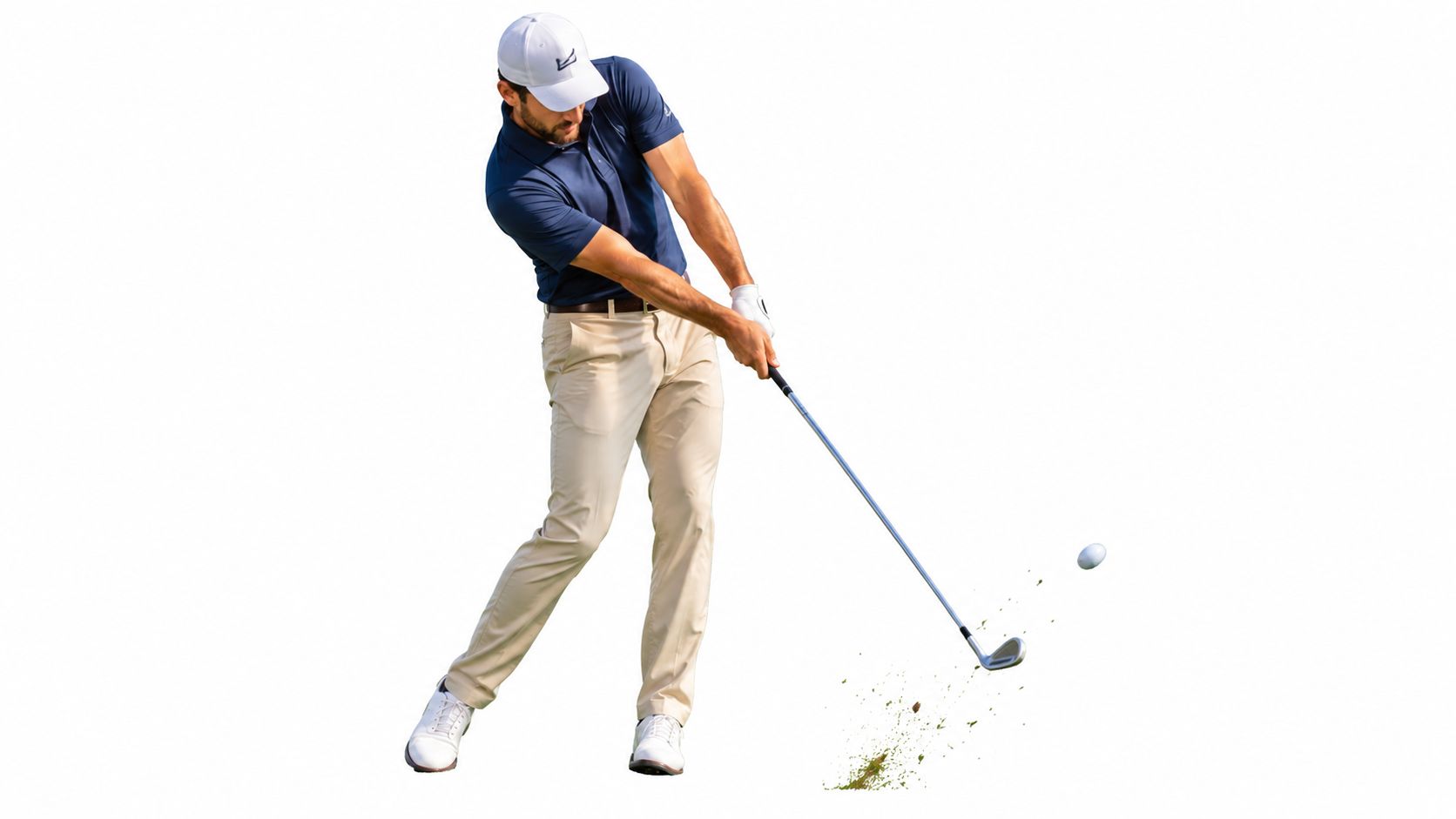
Why older and newer sets can feel unrelated
A golfer moving from an older blade-style set into modern game-improvement irons may gain distance without making a faster swing. The change comes partly from loft, and partly from head construction, face design and the way the club launches a less-than-perfect strike.
That extra carry isn't automatically a free improvement. If the new seven iron flies lower, lands shallower or spins less, a golfer may need to consider whether it still stops on the greens being played. A club that reaches the target but releases through the back can be less useful than a shorter club with a higher descent angle.
Wind adds another layer. A lower flight can be useful into a strong breeze because it exposes the ball to less moving air, but a low-spinning shot can also be harder to hold on a firm links green. A higher-lofted seven iron may offer more stopping power, although the player still needs enough speed and clean contact to create the intended launch.
Loft should be read with launch and spin
Loft isn't an isolated buying decision. A golfer's angle of attack, strike location, shaft delivery and ball choice all affect the result. Two clubs with similar stated loft can still produce different peak heights and descent angles because their heads and shafts are built differently.
The sensible comparison is therefore a launch monitor session or a carefully measured practice session. The useful result isn't only the furthest carry. It is the club that produces a workable launch, reliable carry and a dispersion pattern that leaves manageable next shots.
How Far a 7-Iron Should Realistically Go
There is no honest universal carry distance for a seven iron. Arccos research reported an overall amateur average of 143.3 yards, while the same comparison cited 172 yards for a PGA Tour player measured by TrackMan. The difference is 28.7 yards, or roughly 20.0% relative to the amateur figure, according to the seven iron distance comparison.
Handicap data shows why a single headline number can mislead:
- A scratch golfer averages about 178 yards.
- A 10-handicap golfer averages about 161 yards.
- A 20-handicap golfer averages about 146 yards.
- A 25-handicap golfer averages about 132 yards.
The gap between the scratch and 25-handicap figures is 46 yards, with the scratch result about 34.8% longer. Those figures describe tracked populations, not targets that every golfer should chase.
A more honest distance table
The requested categories are best treated as reference points, not promises. Loft, strike and weather can move a golfer from one category to another, so the carry range should be measured rather than borrowed from a chart.
| Handicap Band | Typical 7-Iron Loft | Carry Range (yards) | Total Range with Roll (yards) |
|---|---|---|---|
| Scratch | Often players' lofts around 33° to 35° | Around 178 yards average in tracked data | Conditions dependent |
| 10 handicap | Varies by set design | Around 161 yards average in tracked data | Conditions dependent |
| 20 handicap | Varies by set design | Around 146 yards average in tracked data | Conditions dependent |
| 25 handicap | Varies by set design | Around 132 yards average in tracked data | Conditions dependent |
A beginner may carry a seven iron well below the figures above, while a fast-swinging player using a strong-lofted head may carry it beyond them. The club's actual loft must be recorded before distance comparisons become meaningful.
Carry is not total distance
A ball that carries 150 yards once but travels 138 yards for most swings should be treated as a 138-yard club, not a 150-yard club. That principle matters in Britain, where wind, cool air, damp turf and soft fairways can make rollout unreliable.
A launch monitor's carry figure is more useful than total distance for approach planning. A golfer selecting a club for a target needs to know where the ball lands, not how far it might roll after landing on an unknown surface.
A normal seven iron number also needs dispersion beside it. A shorter club that finishes within a predictable front-to-back window can be a better purchase than a longer club that occasionally produces an impressive maximum but misses both sides of the target.
Where the 7-Iron Sits in a Modern Iron Set
In a traditional seven-club iron set, the seven iron sits in the middle. Longer irons, or a hybrid replacing one of them, cover longer approaches. The eight iron, nine iron and pitching wedge produce shorter carries with more loft.
The seven iron often becomes the reference point because it is long enough to expose strike and launch problems, but short enough for many players to hit with reasonable control. Fitters can use its delivery to understand whether the rest of the set is likely to produce useful gaps.
The gap must be measured, not assumed
A modern set may place the seven iron around the high twenties or low thirties in loft. Another set may use materially more loft. The club number can't reveal whether the seven iron sits sensibly between the six iron and eight iron.
| Club | Average Loft (°) | Mid-Handicap Carry (yards) | Carry Gap (yards) |
|---|---|---|---|
| 6 iron | Varies by set | Must be measured | Must be measured |
| 7 iron | Commonly varies from approximately 27.5° to 35° | Must be measured | Reference club |
| 8 iron | Varies by set | Must be measured | Must be measured |
| 9 iron | Varies by set | Must be measured | Must be measured |
| Pitching wedge | Varies by set | Must be measured | Must be measured |
The table deliberately avoids pretending that one loft or one carry fits every modern set. A fitter wants a useful progression through the bag, with no awkward overlap between a seven iron, hybrid and pitching wedge.
A strong-lofted seven iron can create a large-looking distance gap to the pitching wedge if the wedge loft hasn't been checked. It may also sit too close to a six iron or hybrid if the player doesn't launch it high enough. The answer isn't automatically to bend clubs. A launch session should first reveal whether the issue is loft, strike, shaft delivery or a missing club.
Set makeup changes the seven iron's job
A short iron set may make the seven iron one of the longest irons in the bag. In a utility-iron combination, it may follow a hybrid or a hollow-bodied long iron rather than a conventional six iron. For a golfer who plays short formats or carries a half-set, the seven iron may be a particularly valuable transitional club.
The key test is whether the club fills a clear distance and trajectory window. If a hybrid flies higher and lands more softly from a difficult lie, it may be more practical than forcing a seven iron into the same role.
When to Use a 7-Iron on the Course
A seven iron earns its place through versatility. A golfer can use it for a full approach, a controlled shot into a breeze, a punch beneath branches or a simple chip that runs like a putt. The correct choice depends on the lie, the landing area and the shot that leaves the smallest likely mistake.
On a normal approach, the seven iron suits a medium-length target where a controlled iron flight can reach the green. A player with a reliable carry can use it on a longer par three or a par four approach, but the stock number must come from that golfer's own measured result.
Change the swing before changing the club
A golfer facing a shorter target doesn't always need to reach for a wedge. A controlled seven iron swing can produce a lower, quieter shot when the lie is clean and the landing area is open. The player should shorten the motion and keep the finish balanced rather than trying to remove distance by slowing the hands.
Into a headwind, a knock-down seven iron can keep the flight below the strongest part of the breeze. The same club can produce a punch beneath tree cover, provided the golfer accepts a lower launch and chooses a safe landing area.
The short-game version
Just off the green, a seven iron can be useful for a chip-and-run. The player makes a putting-style stroke, lands the ball on a predictable patch of green and allows it to release towards the hole. Around a bunker, a bump-and-run can be safer than attempting a delicate lofted shot, especially when the grass is short and the path to the hole is clear.
A seven iron can also act as a flying wedge from a clean fairway lie, although the shot demands a confident strike and enough green to accept rollout. The club isn't the right answer when the ball sits in heavy rough, the stance is on a steep downslope or a front bunker protects a tucked pin.
A seven iron is a good choice when the landing area rewards a controlled flight. It is a poor choice when the lie demands height or the green offers no room for release.
Finding Your Real 7-Iron Number on the Range
A poster at a driving range can provide a rough reference, but it can't account for a golfer's strike, loft, weather or ball flight. A short test gives a more useful number.
Start with contact
After warming up, hit 10 shots with the seven iron. The purpose is contact, not distance. A crisp strike with the ball first and the turf after the ball gives cleaner information than a group of rushed swings.
The player should record the normal carry, not the best result. If one strike flies unusually far, it belongs in the notes as an outlier rather than becoming the club's new stock number.
Add dispersion
Next, hit 20 full shots towards a target. Record the shortest carry, longest carry and average, then note whether the normal shots land short, long, left or right. A golfer who produces a slightly shorter but narrow pattern may have a more useful scoring club than one who produces a longer average with wide misses.
A launch monitor session can make this process easier. Fayrway includes simulators and launch monitors among the equipment categories available to golfers comparing carry and dispersion.
Test the British variables
The final test should include different wind directions where possible. Hit shots into a headwind and downwind, then compare how much the carry and trajectory change. The point isn't to create a perfect laboratory result. It is to understand whether the seven iron is stable enough for the conditions regularly faced on UK courses.
A casual nine holes can confirm whether the range number translates to play. A rangefinder, honest strike notes and the actual lie provide better evidence than a single maximum distance.
England's World Handicap System uses the average of a player's eight best score differentials from their most recent 20 rounds, as described by England Golf's handicap information. That system reinforces a sensible approach to club selection. The useful seven iron is the one that supports repeatable scoring, not an isolated highlight shot.
Buying, Replacing and Fitting the 7-Iron
Replacing one seven iron makes sense when the original has been lost, badly bent or worn through repeated use. A full set fitting makes more sense when the seven iron no longer connects cleanly to the six iron, hybrid, eight iron or pitching wedge.
The fitting variables with the biggest practical effect are lie angle, shaft length, shaft weight, flex and grip thickness. Lie angle can influence start direction. Length changes strike location. Shaft weight and flex affect timing and delivery, while grip thickness can alter how comfortably the player controls the face.
A colder, damp round can expose a marginal fit because contact becomes less reliable and fairways offer less predictable rollout. That doesn't mean a heavier shaft automatically tightens dispersion for every golfer. It means the player should test weight and feel rather than choosing from a generic flex label.
Choose the head for the job
Game-improvement heads generally prioritise forgiveness and launch. Players-distance heads sit between forgiveness and a more compact appearance. Blades place greater emphasis on control, feedback and strike quality, but they demand a more reliable delivery.
A seven iron at £60 and one at £900 may differ in construction, fitting options, condition, set context and materials. Price alone doesn't reveal whether either club suits a particular golfer. A player needs to compare carry, launch, dispersion and gapping with the actual shaft and lie.
Groove condition also matters. The R&A Equipment Rules state that the spacing between adjacent groove edges must be at least three times the groove width and no less than 0.075 inches, or 1.905 mm, while groove depth must not exceed 0.020 inches, or 0.508 mm. Competitive golfers can check equipment status through the R&A groove and club conformance rules.
An in-person launch monitor session remains more informative than guessing from an online questionnaire. The seven iron gives the fitter a reference for the rest of the set, but the final decision should reflect the golfer's strike, carry window, weather and intended course use. Guidance on choosing a stiff or regular flex shaft can help, but measured delivery should settle the question.
Fayrway offers a curated range of golf irons and fitting-led equipment guidance for UK golfers comparing loft, shaft and set makeup. Visit Fayrway to explore options suited to the golfer's carry window, course conditions and wider bag.
Frequently asked questions
Is a seven iron the same loft in every set?
No. Published current specifications span approximately 27.5° to 35°, so the stamped number cannot be used as a complete equipment comparison.
What is a realistic seven iron distance?
Tracked averages range from about 132 yards for a 25-handicap golfer to about 178 yards for a scratch golfer, but individual carry depends on loft, speed, strike and conditions.
Should carry or total distance be used for club selection?
Carry should be the main measure. Rollout changes with landing conditions, turf firmness and weather, making total distance less reliable in British conditions.
Is a shorter seven iron sometimes better?
Yes. A shorter club with tighter front-to-back dispersion and predictable stopping power can be more useful than one that produces a longer maximum shot.
When should a golfer use a hybrid instead?
A hybrid may be preferable when the seven iron struggles from a poor lie, when the golfer needs a higher launch or when the club fills a clearer gap in the bag.
Does a golfer need a seven iron at all?
Not necessarily. A half-set, hybrid combination or progression set may suit a beginner, junior, casual golfer or player who rarely uses traditional long irons better than a full conventional iron set.


