
Buying Guides
Best Putter for Beginners: How to Pick the Right One
Sandy Grewal · 17 November 2026
Table of Contents

Most beginner putter advice stops at one word. Mallet. Buy the biggest, most forgiving head you can find, and the putts will start dropping. That's half the job, and it misses the part that costs shots: a forgiving head bolted to a shaft two inches too long still leaves you aiming from the wrong place and hitting putts with no feel for pace. The best putter for beginners is a stable mallet or semi-mallet, balanced for the way your stroke moves, cut to a length that lets your arms hang, and settled on a real green by how well you control distance.
Beginner Putter Styles at a Glance
Head shape is the easy half of a first putter. Higher-handicap golfers leave more putts short than they miss them wide, so pace feedback belongs beside alignment and sweet spot when you choose. Start with a forgiving mallet or semi-mallet, match its balance to the way your stroke moves, and look at brand and finish last. Forgiveness at this stage means a bigger sweet spot and a sightline you can trust at address.
England had 750,071 golf-club members in 2025, up from 730,602 in 2024, on England Golf data reported by Membership Quest. Plenty of those golfers are new or coming back. A first putter often gets bought after a single round, before any handicap exists to steer the choice.
Beginner putter styles matched to stroke type
| Putter style | Stroke it suits | Forgiveness | Watch out for |
|---|---|---|---|
| Face-balanced mallet | Straight back and through | High | Check the face stays square at address |
| Toe-hang mallet | Arcing stroke | High | Face rotates more on off-centre strikes |
| Toe-hang blade | Arcing stroke | Medium | Smaller sweet spot and less alignment help |
| Face-balanced blade | Straight back and through | Medium | Limited sightline and less margin on mishits |
| Semi-mallet | Either, depending on balance | Medium to high | Balance decides the stroke it suits, so test before buying |
Read the rows by stroke first, then forgiveness. A high-MOI mallet that fights an arc still starts the ball offline. A blade with the right toe hang will not save a putt that dies two feet short. Pick the style that matches the stroke, then judge it by how cleanly you control distance, on parkland, links or an indoor mat.
Test Your Stroke, Face and Setup Before You Choose
Face angle sends the ball. Head shape comes after that.
A putting stroke guide on learn-golf.co.uk puts face angle at impact at about 80% of directional consistency, with path contributing roughly 17% (putting stroke guide). Straight stroke, face-balanced putter. Arc, toe hang. That shortcut still narrows a shortlist, and it is a weak first filter. Get the setup and the length right, then see whether the face stays square and whether the ball reaches the hole. Higher-handicap golfers leave more putts short, so pace feedback belongs in the choice alongside head shape.
Eyes sit directly over the ball line, or a fraction inside it. Arms hang with a slight bend. Keep the grip light enough that the shoulders move the head. A putter that is too long forces the eyes inside the line and the hands high, and the face aims right without you noticing. If length against your height is unclear, the guide to what size golf clubs you need covers the measurement.
The fifteen-minute stroke test
Run this on a practice green, in order.
- Hit ten putts from 2 m and watch the shoulders and arms. If they move as one unit with quiet hands, you're closer to straight back and through. If the hands rotate around your body, you have an arc.
- Film one putt from down the line, camera at waist height about 1 m behind the ball. You're checking whether the face stays square to the target line through impact, which the naked eye can't judge.
- Match the result to balance. Square face with a straight stroke points to face-balanced. A face that opens and closes points to toe hang.
- Balance the shaft on one finger. A head that drops toe-down is toe-hang; a head that sits level is face-balanced. It takes five seconds and settles most arguments.
- Repeat at the end of the session, and watch where the ball finishes. Fatigue changes the stroke. Putts that keep dying short mean the head is not giving you pace you can read, whatever the balance says. A putter that only works when you're fresh fails on the 16th.
Practical rule: fix the setup and the length before you change the head. A badly aimed, badly sized putter cancels whatever forgiveness the head offers.
Shortlist two balance options and one length, then compare them on the same green. Note start line and whether the ball gets to the hole. Buying online is fine once those are settled, and a waste of postage before.
Mallet Versus Blade for Beginners
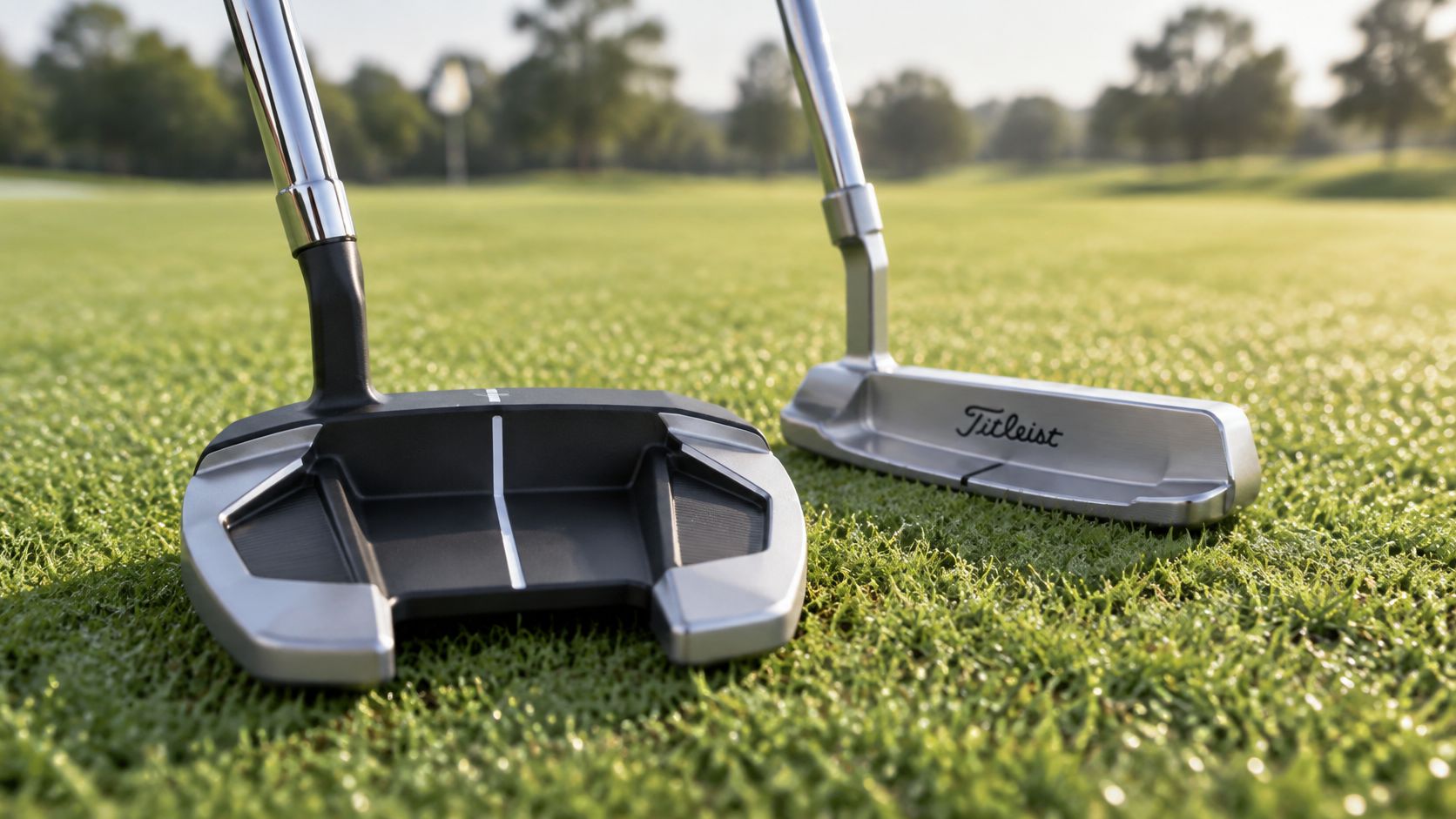
A mallet is the stronger starting benchmark for most UK beginners, and it isn't close.
The deeper head lets mass sit farther back and wider, which raises resistance to twisting on off-centre strikes and gives room for alignment lines and a clear sightline. Those two fixes, a stable face and a start line you can see, address the two errors beginners make most. A UK equipment comparison reports Shot Scope data for a 15-handicap benchmark: six-foot make rate rose from 75% with a blade to 82% with a mallet, while average three-putts fell from 2.6 to 2.3. Not a guarantee for any individual, but a sensible target when you compare two putters on the same green.
Two shapes, two different jobs. The head should follow the strike, not the finish.
When a blade is the right call
A blade suits a player who already finds the centre of the face and wants honest feedback. The head is simpler to read, the feel tells you exactly where you struck it, and a beginner with a repeating stroke loses nothing by using one. Choose it on strike consistency, not on looks.
The trade-off runs the other way. Mallet feedback is muted, which can hide a strike problem for months. Run a session where you note which putts finish short or wide, not just how they felt.
Whatever mallet you shortlist, check three things: a sightline you can square the face to without thinking, a head weight that doesn't feel toppy in the stroke, and a head size that sits comfortably behind the ball at address. Brand and finish come after those. The Journal's blade versus mallet putters comparison goes deeper on both families.
Loft and Impact Conditions That Change Roll
Buyers spend the fitting on head shape. Loft sets how long the ball skids before it rolls, and that skid is where pace falls apart. On a first putter, the loft you deliver matters as much as the silhouette.
A Sheffield Hallam University experiment tested identical blade putters between minus 1° and 5° of loft using a mechanical putting machine, high-speed video, artificial turf and natural greens. Roll ratios differed significantly between most loft conditions, and the negative-loft putter produced the greatest roll ratio and the most consistent final distance in that Sheffield Hallam putting-loft study.
Read the result as a note on delivered loft. Forward lean at impact reduces effective loft. A descending or upward strike changes launch and skid, so you send the ball away with a different loft from the number stamped on the sole.
Test it, don't trust the spec: compare candidate putters from 2 to 4 m on a real or representative green, and record where the first putt finishes rather than how it felt.
Set a fixed number of putts, ten is enough, and log two things: finishing distance and whether the ball started on line. Buy the model that repeatedly finishes inside a tight distance window and starts the ball where you aimed, even if the head looks plainer.
Hands-forward setups often deliver less loft than the sole stamp. Ask a fitter to check dynamic loft and shaft lean at impact before you commit to a low-loft head. Match the loft to that lean, then judge the putter on how tightly it holds finishing distance. Head shape comes after the roll is honest.
Pace Control and Practising on UK Greens
This is the part most buying guides skip. Beginners lose more shots to distance than to head shape. Shot Scope data reported in beginner putter guidance shows a 25-handicap golfer leaves 59% of putts short, against 55% for a 15-handicap. Leaving putts short is a habit that survives an upgrade, which makes pace feedback the feature worth testing hardest.
Head weight, insert feel, length and balance all feed information back to your hands. A heavier head swings more smoothly and quietens the hands; a softer insert takes the sting out of a firm strike but can mute the feedback that teaches you distance. Reading pace is half the job, and it's the half that improves fastest with a putter that tells you the truth.
UK green conditions and the pace focus for each
| Condition | What changes | Practice focus | Putter feature to check |
|---|---|---|---|
| Slow, soft winter greens | Ball needs more speed and short putts can stop early | Firmer stroke and pace from mid-range | Head weight that gives clear feedback |
| Fast, firm summer greens | Ball runs past the hole and over-hitting is common | Short, controlled strokes | Softer feel and balance that stops over-hitting |
| Links and seaside turf | Wind and firm surfaces change speed across the same green | Uphill and downhill pace | Stable head and balance that holds through the stroke |
Run a routine that produces numbers rather than impressions. Putt to a tee at 3 m and again at 8 m, ten balls at each, and mark every ball short, long or inside a makeable range. Adjust feel and weight to that pattern, not to the label on the box.
Indoor work counts. Fayrway lists the SwingPlate Putting Gate Precision Golf Training Aid at £19.99, which gives you a square-face check without needing a green. Golfers practising at home can also follow this putting green guide for Indianapolis golfers for surface and setup ideas that translate to a UK mat. More structured drills sit in the Journal's golf training aids guide.
Choose Your Beginner Putter by Situation
Buy for the situation in front of you, not for a premium badge. The stroke test has already settled balance. What is left is length, grip, handedness, budget, and whether the head tells you the truth about pace.
Higher-handicap golfers leave more putts short. Pace feedback should weigh as much as head shape on a first putter.
Beginner putter starting points by situation
| Situation | Start with | Check first |
|---|---|---|
| Consistent short misses | A head with clear face feedback and steady weight | Finishing distance over repeated putts |
| Junior player still growing | Shorter length and a lighter grip | Length against posture, then grip size in the hand |
| Left-handed player | A left-handed model under the same balance rules | Handedness on the spec, then shaft lean at address |
| Tight budget, mostly casual rounds | A plain-finish mallet with a stable head | A head that stays stable and a grip that is secure |
Junior golf-club membership in England rose from 46,028 in 2024 to 61,483 in 2025, an increase of 34%, on England Golf data reported by GolfMagic. A junior needs length and grip that match their size. An adult putter cut down ruins posture before it ruins the stroke.
Budget rule: a plain-finish mallet with a stable head beats a premium model whose balance does not match your stroke. Past a certain price you are paying for a badge.
Roll the shortlist from 2 to 4 m before you pay. Short, long, or inside a makeable range shows whether that head's feedback suits the greens you play.
Frequently asked questions
How do I know a putter is the wrong length?
Your setup gives it away before the ball does. Reaching for the ball, or crouching to sole the head, means the shaft does not match your posture. Fix length first. A prettier head will not correct a hunched address.
Can I buy my first putter online?
Yes, once length, balance and grip are settled and you have read the returns policy. Ordering on the badge alone is where online buying goes wrong. Free UK delivery over £50 and 30-day returns mean a poor match can go back.
Do I need a fitting?
A fitting earns its fee when posture, handedness or body shape does not match off-the-shelf options, particularly for left-handed golfers. Most beginners should settle those checks themselves before paying anyone.
Is a second-hand putter a sensible first buy?
Yes, if the head is undamaged, the grip is secure, and balance and length still hold. A worn grip is cheap to replace. A bent shaft or a cracked insert is not.
What should I read before I compare models?
Fayrway notes suitability by skill level, playing conditions and handedness alongside each pick. Match that note to how you play and which hand you use. Skip a model whose note describes a different player, however strong the finish looks.
If you leave putts short, weigh pace feedback as heavily as head shape. A stable head helps the line. It does not tell you how hard to hit the ball. Keep the putter that shows distance clearly.
Pros' Picks reflect items the roster reaches for in lessons and play. Compare the current models against those suitability notes, then order from Fayrway.


