
Buying Guides
56 Degree Wedge Guide: Loft, Bounce, and When It Fits
Sandy Grewal · 29 September 2026

A 56 degree wedge is the traditional UK sand wedge loft, and it remains the right all-round choice for bunker escapes, chips, and controlled pitches. It sits between a pitching or gap wedge and a lob wedge, but it isn't the club for every full approach.
The popular advice is to buy the loft printed on the head and worry about the rest later. That's how golfers end up with a wedge that digs into wet parkland turf, skips off firm links ground, or leaves an awkward gap beside the pitching wedge. Bounce, sole shape, carry distance, and course conditions matter as much as 56 degrees.
What a 56 Degree Wedge Actually Is
The traditional sand wedge
A 56 degree wedge is the classic sand wedge in British golf. UK buying guidance commonly places sand wedges between 54 and 56 degrees, with 56 degrees treated as the traditional choice for bunker escapes, fairway chips, and versatile greenside shots. GolfMagic's UK wedge guide places the loft in the standard progression from pitching wedge to gap wedge, sand wedge, and lob wedge.
The loft opens the face enough to launch a bunker shot over the lip while retaining more control and forward carry than a 58 or 60. That makes it a practical workhorse, not a specialist club reserved for confident low handicappers.
Practical rule: A 56 is primarily a short-game and bunker club. Treat it as a controlled scoring club, not as a replacement for every short iron.
Its three main jobs are straightforward:
- Greenside bunker escapes, where the sole needs to slide through sand rather than knife into it.
- Chips from the fringe or rough, especially when the ball needs a reliable amount of carry before releasing.
- Controlled pitches inside roughly 80 yards, with distance controlled through swing length and strike rather than simply hitting harder. UK distance guidance commonly places a 56 degree wedge in the 70 to 95 yard full-swing range, with one UK-oriented guide describing roughly 70 to 85 yards for the average golfer. Golf Decode's wedge distance guide provides the wider range, while Learn Golf's UK loft guide gives the more conservative average reference.
The wrong 56 fights the golfer on every green. The rest of the buying decision comes down to bounce, grind, gapping, and whether a 54 or 58 would suit the bag better.
Where a 56 Degree Wedge Sits in Your Set
Modern iron sets have made wedge gapping less obvious. A pitching wedge may now be 43 to 46 degrees, so adding a traditional 56 beside it can leave a large distance hole. UK fitting guidance recommends 4 to 6 degree loft gaps, which usually produces around 10 to 15 yards of separation between adjacent wedges when they're struck properly. Learn Golf's wedge loft guide explains why that spacing matters.
A common ladder starts with a pitching wedge, moves to a gap wedge around 48 to 52 degrees, then reaches the sand wedge slot at 54 to 56 degrees. Lob wedges often begin around 58 degrees. In practical terms, a 56 is the middle ground between a lower, longer approach wedge and a high, short lob wedge.
Typical Wedge Loft Ladder in a UK Set
| Wedge | Loft (degrees) | Approx Carry (yards) | Typical Role |
|---|---|---|---|
| Pitching wedge | 43 to 48 | Not fixed | Full approaches and lower flight |
| Gap wedge | 48 to 52 | Not fixed | Fills the pitching wedge to sand wedge gap |
| Sand wedge | 54 to 56 | 70 to 95 | Bunkers, pitches, and general short game |
| Lob wedge | 58 to 60 | Not fixed | High shots, short-sided pins, and speciality recovery |
The carry figure for the sand wedge is a broad guide, not a promise. Golf Decode places many 56 degree wedges in the 70 to 95 yard full-swing range, but strike, speed, lie, and weather quickly alter the result.
A single-figure player might carry 48, 52, 56, and 60 degrees. That's a sensible four-wedge setup if each club has a distinct job and the player regularly uses the full spread. A recreational golfer may be better served by fewer wedges and a simpler decision process. Fayrway's bag organisation guide is useful when checking whether the wedge arrangement is costing space needed elsewhere.
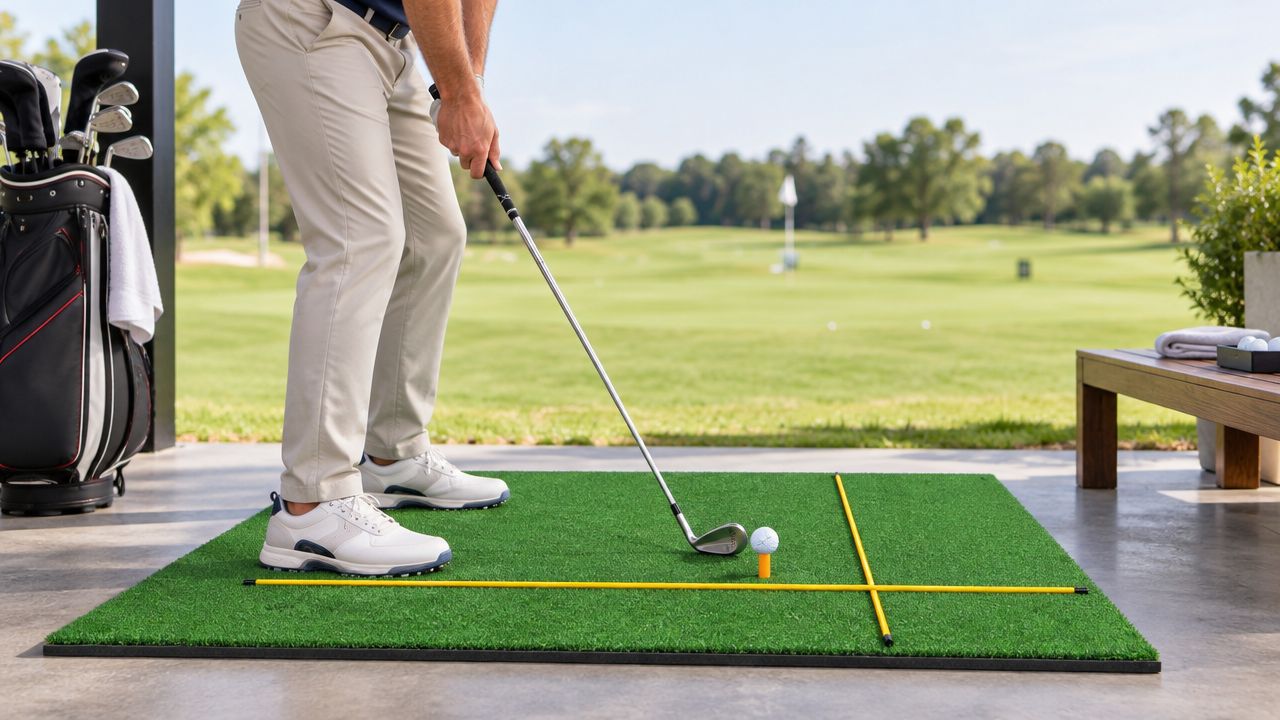
For golfers who practise at home, the Premium Golf Practice Hitting Mat 3-In-1 with Synthetic Grass Turf-27 mm is designed for driving, chipping, pitching, and target practice, with tee holes for left and right-handed golfers and an alignment stick included. It rolls up for storage, which suits British weather when a range session isn't practical.
Bounce and Grind on a 56 Degree Wedge
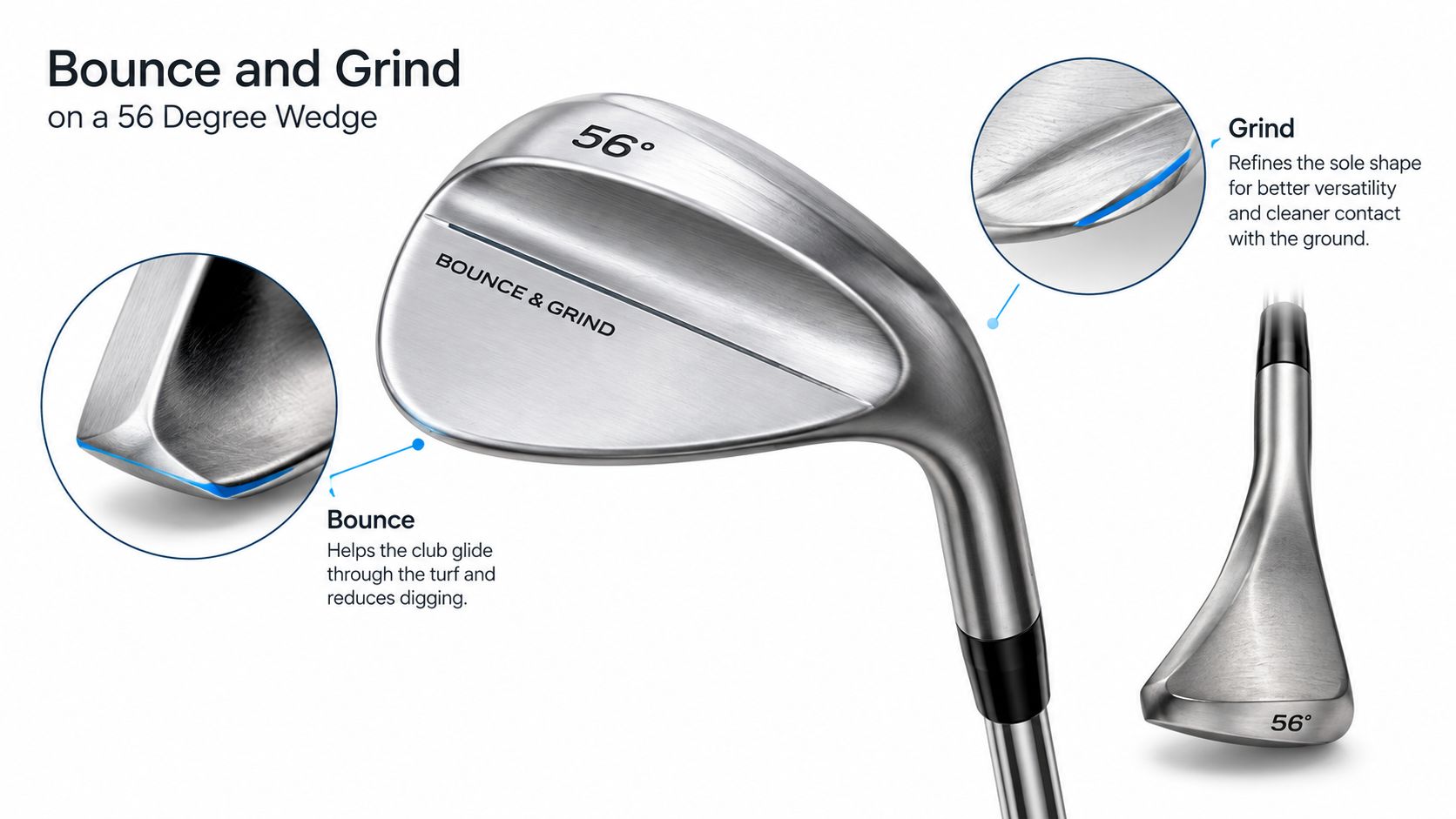
Bounce is the angle between the sole and the ground. Grind describes how the sole is shaped, including which areas are removed or widened to change turf interaction. Those details determine whether a 56 glides through the ground or digs into it.
On wet winter rough, the club needs help getting through soft turf. A higher-bounce sole lets the bottom of the club skid rather than bury itself. On hard, baked links turf, too much bounce can make the leading edge sit high and strike the ball thin.
Match bounce to the course
For British conditions, the useful ranges are practical rather than theoretical:
- Firm links and tight parkland lies: about 8 to 10 degrees is a sensible starting point, with lower bounce useful for a shallow delivery.
- Typical parkland and heathland: around 10 to 12 degrees gives a dependable compromise.
- Soft, lush inland courses and heavy rough: roughly 12 to 14 degrees helps the sole move through damp ground.
UK bounce guidance also places mostly parkland play around 10 to 12 degrees, softer winter or damp turf around 12 to 14 degrees, and firm links around 8 to 10 degrees. Launch Point Golf's bounce explanation links higher bounce with more sole skid in soft ground and lower bounce with cleaner contact from firm lies.
A low-bounce 56 can be a miserable choice from a wet pot bunker or heavy Surrey heathland turf. A high-bounce model can skip off a bare lie on a Scottish links in July. The same loft behaves differently because the sole meets the ground differently.
The working shop rule: Most UK amateurs playing parkland golf through the year should start around 10 to 12 degrees of bounce, then move lower or higher only when the course and delivery demand it.
Attack angle matters too. Steeper golfers generally benefit from more bounce, while shallow golfers on firm ground often need less. The Golf Ace's wedge distance guidance explains the basic relationship between bounce, turf softness, and delivery.
A golfer working on contact can also use the 83mm Green 10° Angled Golf Tees as a consistent tee-height aid during practice, although the tees don't alter how a wedge's sole interacts with turf. For wedge work, the useful test remains simple, hit from different lies and watch whether the leading edge digs or the sole skips.
Shots You Should and Should Not Play with a 56
The 56 earns its place through versatility, but versatility doesn't mean it's ideal for every shot. A golfer who tries to force it into speciality situations usually creates more risk than necessary.
Bunker escapes
From a normal greenside bunker, the 56 is the default choice. Open the face slightly, use the bounce, and let the club enter the sand behind the ball. The aim isn't a perfect strike on the ball. It's a predictable splash that gets the ball over the lip and onto the green.
A very high bunker lip changes the decision. When the ball needs to climb sharply with little green available, a 58 or 60 gives more loft and a steeper landing angle. A 56 can do the shot, but it asks for more face opening and more speed, which isn't a good bargain for most amateurs.
Chips from rough or the fringe
The 56 works well when a chip needs some carry and a controlled release. It's especially useful from rough where a lower-lofted iron may catch grass behind the ball or run too far after landing.
From a tight, firm lie, the club becomes less forgiving. A low-bounce sole can help a shallow striker, but a steep swing may drive the leading edge into the turf. For a simple bump and run, a pitching wedge or gap wedge often offers more margin.
Controlled pitches
Inside roughly 80 yards, the 56 is useful for controlled pitches, particularly when the ball needs to land softly rather than run. Golf Decode gives a typical full-swing range of 70 to 95 yards, while Learn Golf describes the average 56 as covering about 70 to 85 yards.
Stronger players may find a full 56 travels too far for a 100-yard pitch. Taking too much loft off or moving the ball too far back tends to produce a low flight and reduced stopping power.
The most useful practice pairing is a standard bunker escape and a pitch from 20 metres. Those two shots cover a large share of recovery situations on British courses without asking the golfer to turn the club into a lob wedge.
Gapping Your Wedges Around a 56 Degree
A 56 should earn its place through a clear carry number, not because the loft sounds traditional. UK fitting guidance commonly uses 4 to 6 degrees between wedges and expects roughly 10 to 15 yards between adjacent full-swing clubs. Learn Golf's UK wedge guide uses that framework to reduce awkward in-between distances.
The classic three-wedge arrangement is 52, 56, and 60. It works when the pitching wedge is close to 48 degrees and the golfer wants a dedicated high-loft option. The problem is that many modern pitching wedges are stronger, so a 52 can leave a less comfortable relationship with the pitching wedge.
For most club golfers, 50, 54, and 58 is often the cleaner three-wedge setup. It keeps the loft steps even, avoids making the 60 the default rescue club, and gives the player a slightly more forgiving high-loft option than a 60.
Three-Wedge Gapping Options Around a 56 Degree
| Setup | Pitching Wedge Gap | Middle Wedge | Lob Wedge | Best For |
|---|---|---|---|---|
| 52, 56, 60 | Around 4 degrees from a 48 degree pitching wedge | 56 degrees | 60 degrees | Players wanting a traditional full spread |
| 50, 54, 58 | Works well beside a stronger pitching wedge | 54 degrees | 58 degrees | Most club golfers wanting simpler gaps |
| 52, 56, 60 with a strong pitching wedge | Can become wider than intended | 56 degrees | 60 degrees | Players who have checked actual carry distances |
A four-wedge 48, 52, 56, 60 setup suits a low handicapper who uses every club. It doesn't suit a golfer carrying a hybrid or fairway wood that already fills an important long-game gap.
Women and senior golfers can see tighter yardage separation because their swing speeds and set designs differ. Loft spacing still matters, but the only reliable test is carry distance for the individual player.
How many wedges do you actually need provides a useful way to judge whether another wedge fills a real scoring gap or merely adds another club to think about.
Fitting a 56 Degree Wedge to Your Skill Level
A 56 behaves differently depending on strike, attack angle, and the golfer's usual lies. Buying advice should begin with those factors, not with a tour player's grind.
Beginners
Beginners generally need forgiveness before workability. A cavity-back 56 with a wide sole and 10 to 12 degrees of bounce gives a better starting point than a narrow, low-bounce blade. The priority is clean contact from grass and sand, not extracting maximum spin from a perfect strike.
A single versatile 56 is enough for most new golfers. Learning one reliable bunker and pitch technique will produce more useful progress than rotating between several lofts and bounce options.
Improvers
Improvers should commit to one standard 56 and learn how it moves through the turf. A mid-bounce sole is usually the sensible choice for mixed UK parkland conditions, particularly when the same course changes from firm summer lies to wet winter ground.
The club should feel consistent beside the rest of the set. A shaft that is dramatically heavier or lighter than the irons can make distance control feel disconnected, even when the loft and bounce are suitable.
Single-figure players
Single-figure golfers can justify a more specialised grind if the course and technique support it. Lower bounce can help a shallow striker on firm links, while a more shaped sole gives a player more options when opening the face.
The shaft still needs to match the set. A workable head with the wrong weight creates a different problem, especially on partial shots where rhythm matters more than maximum speed.
Women and juniors
Women and junior golfers shouldn't be fitted into a standard adult men's profile by default. Lighter graphite shafts, shorter lengths, and suitable lie angles may improve control, while steeper attack angles can make a higher-bounce 56 easier to use.
Distance gaps may compress, so lofts should be checked by actual carry rather than assumed yardage. A simpler setup is often more useful than copying a four-wedge arrangement designed for a faster swing.
For UK course conditions, a practical starting point is 6 to 8 degrees for firm summer links, 8 to 10 degrees for all-year parkland, and 10 to 12 degrees for heavy winter ground. Those ranges reflect the interaction between bounce, turf, and attack angle, not a universal handicap rule. Golf Gear Direct's fitting guidance highlights why the same 56 can perform very differently from one course to another.
Choosing Your 56 Degree Wedge in the Pro Shop
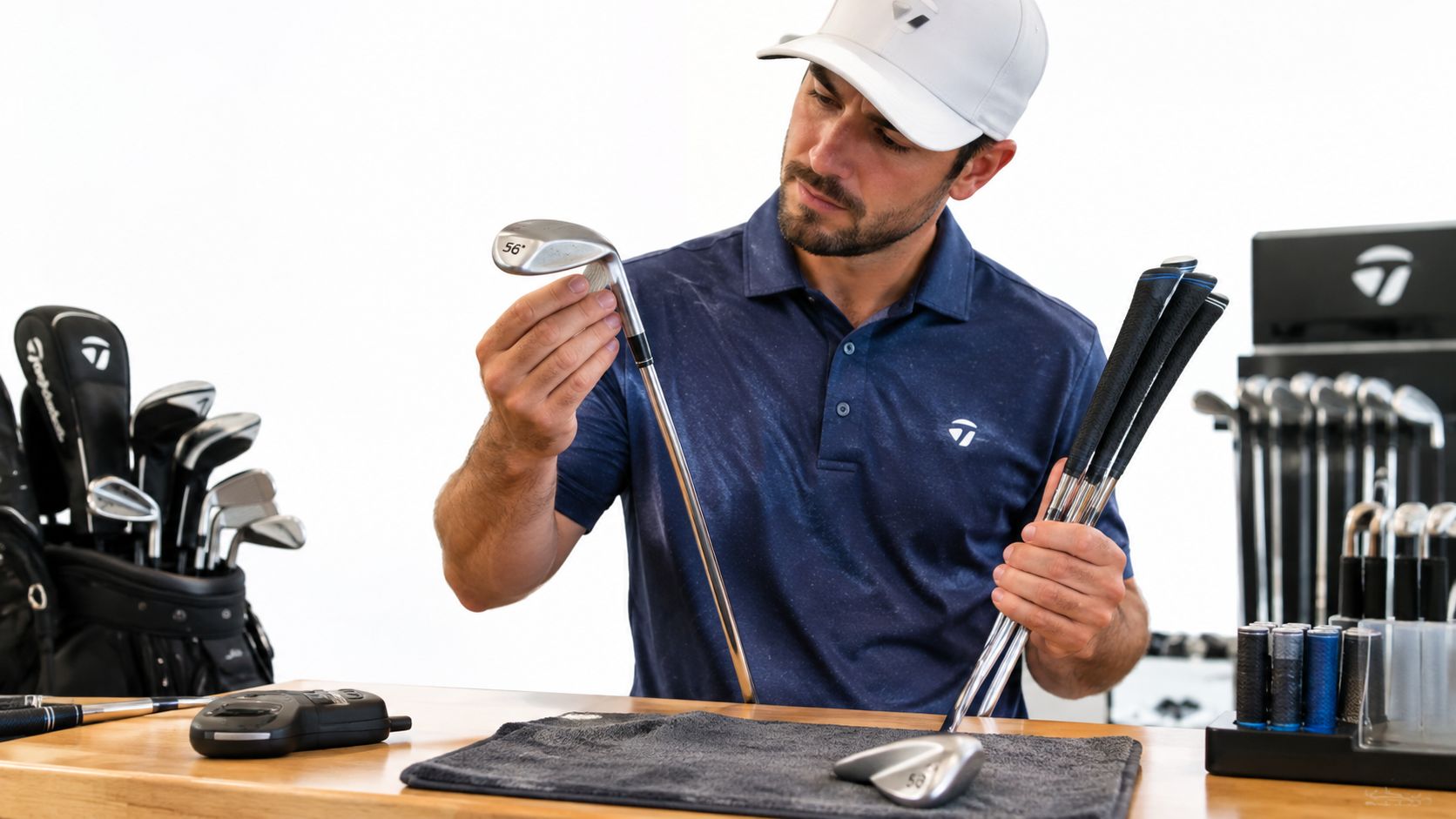
The right club should pass a physical test before it passes a brand test. Start with the sole on a flat surface. The leading edge shouldn't look as though it wants to dig, and the grind should sit naturally rather than forcing the face open or shut.
Check the grip thickness against the rest of the set. Then feel the shaft weight. If the 56 feels out of step with the irons, partial pitches and bunker swings may become harder to repeat.
The shop-floor test
- Start with chips: Hit 8 to 10 chips from a mat or short-game area, then watch the strike and turf interaction rather than the spin display.
- Test a bunker lie: Hit three shots from a flat bunker lie. The sole should slide without the head bouncing violently or burying itself.
- Change the ground: Hit three chips from a tight, dry lie and three from damp winter rough. A suitable bounce choice should give useful contact from the lies the golfer faces in real play.
- Ask about the set: Confirm the loft and bounce, shaft weight, length, lie, and whether the wedge can be adjusted to fit the rest of the bag.
Shiny cosmetic shaping can hide a harsh leading edge. Mixed-set swingweight mismatches can also go unnoticed when a golfer only makes one full swing indoors. A tour-inspired grind isn't automatically right for a wet parkland course.
Fayrway's wedge collection gives golfers a focused place to compare wedge types while keeping the decision centred on loft, bounce, playing conditions, and ability. The useful question isn't which wedge looks most impressive. It's which sole lets the golfer strike the ball without fighting the ground.
Frequently Asked Questions
Can a 56 replace short irons?
Not properly. A 56 is useful for controlled pitches and short-game shots, but it won't replace the height, carry, or predictable full-swing distance of an 8 or 9 iron.
Is a 56 better than a 58?
For most beginners and recreational golfers, yes. A 56 is generally the more versatile bunker and pitching club. A 58 becomes the smarter choice when a golfer regularly needs extra height or wants a middle option between a 56 and 60.
What should happen if a 58 is already in the bag?
Keep both only when they have separate jobs and carry distances. The 56 can handle fuller pitches and standard bunker shots, while the 58 can cover higher bunker lips and short-sided recovery shots. If the two clubs overlap, removing one usually makes the bag simpler.
How can bounce be tested during a round?
Use ordinary shots from a tight lie, damp rough, and a bunker. If the club digs on soft ground, more bounce may help. If it skips or catches the ball thin from firm ground, the sole may be too broad or too high-bounce for that delivery.
Is graphite or steel better?
Neither is automatically better. Steel often suits golfers who want a familiar, stable connection with an iron set, while graphite can suit players who need less overall weight. The shaft should match the golfer's strength, tempo, and existing set.
Should beginners compare several bounce options?
No. Beginners should start with one versatile grind, normally around 10 to 12 degrees of bounce for mixed UK conditions. More options make sense after the golfer can identify whether the miss comes from technique or turf interaction.
Fayrway offers a focused range of wedges curated by pros, with guidance built around ability, handedness, and playing conditions rather than marketing language. Visit Fayrway to choose a 56, 54, or 58 degree wedge that fits the rest of the bag and the courses played most often.


