
Comparisons
How Many Wedges Do You Actually Need?
Fayrway Pros · 27 August 2026
Table of Contents

Most club golfers need three wedges: a pitching wedge, a sand wedge and one more in between or below them. The pitching wedge already lives in your iron set, so in practice you are choosing one or two extra wedges. Beginners can play happily with just a pitching wedge and a 56 degree sand wedge until the short shots start to matter.
The wedges are the clubs you use closest to the hole, where scores are won and lost, so it is worth understanding what each one does before you fill a slot for the sake of it. Below is a plain guide to how many wedges you actually need, which lofts to pick, and how to build a set that leaves even, playable gaps.
How many wedges does the average golfer need?
Three is the sweet spot for most golfers, including the pitching wedge that comes with your irons. That gives you a pitching wedge around 44 to 46 degrees, a sand wedge around 54 to 56 degrees, and one wedge to bridge or extend that range. Two wedges is fine while you learn, and four suits low handicappers who want a dedicated club for every yardage inside 120 yards.
The reason three works is spacing. A typical pitching wedge and a sand wedge sit around 10 degrees apart, which leaves an awkward distance gap of 20 to 30 yards in the scoring zone. A third wedge closes that gap so you are swinging fully rather than guessing at half shots.
What do the different wedges actually do?
Each wedge is defined by its loft, and loft controls how high and how far the ball goes. There are four common types, and you do not need all of them.
- Pitching wedge (44 to 48 degrees). Your longest wedge, usually part of the iron set. Full shots into greens from around 100 to 120 yards.
- Gap wedge (50 to 52 degrees). Named because it fills the gap between the pitching and sand wedge. Handy for three quarter approach shots.
- Sand wedge (54 to 56 degrees). The most useful single wedge to own after the pitching wedge. Bunkers, thick rough and higher pitches around the green.
- Lob wedge (58 to 60 degrees). The highest, shortest club. Flop shots and tight pins, but the hardest wedge to hit cleanly.
How should I space my wedge lofts?
Aim for even loft gaps of four to six degrees between wedges. Uneven gaps are the most common mistake: a golfer buys a 60 degree lob wedge to sit under a 46 degree pitching wedge and skips everything in between, leaving a 14 degree hole that translates to a 40 yard distance gap.
A clean three wedge setup might read 46, 52 and 58 degrees, or 44, 50, 56 and 60 if you carry four. Check the loft stamped on your pitching wedge first, because modern game improvement irons are stronger lofted than they used to be, then build the rest around it in even steps.
How many wedges does a beginner need?
Two is plenty when you start: the pitching wedge from your set plus one sand wedge around 56 degrees. That covers full approach shots, greenside chips and getting out of bunkers, which is where new golfers lose the most shots. Add a gap or lob wedge later once you can control distance with the two you have.
A ready made three wedge set is the simplest way to get evenly spaced lofts without picking clubs one at a time. This one gives you the gap, sand and lob wedges in matched steps, so you can add all three to your bag at once and grow into the lob wedge.
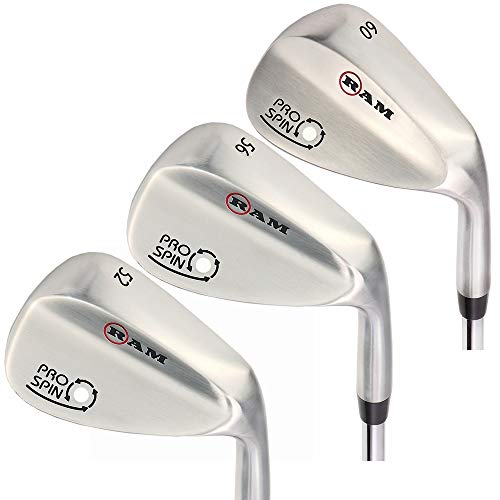
Ram Golf Pro Spin 3 Wedge Set
- Matched 52, 56 and 60 degree lofts
- Even gaps straight out of the box
- Milled faces for greenside spin
Price on Amazon
£59.99
If you would rather add a single wedge and keep it simple, a well made stainless steel wedge covers the most important slot next to your pitching wedge. This 52 degree option is an easy first step up from a bare iron set.

Ben Sayers XF Pro 52 Degree Wedge
- Recognised UK golf brand
- Stainless steel head for durability
- Fills the gap next to your pitching wedge
Price on Amazon
£22.99
Do I really need a lob wedge?
Not at first, and many mid handicappers play better without one. The 60 degree lob wedge is the hardest club in the bag to strike consistently, and a mishit flop can cost you two shots rather than save one. Learn to control a sand wedge on higher pitches before you add a lob wedge, then bring it in only if you face tight, short sided pins often.
Once you know how many wedges you want, choosing the right models matters more than the badge on the sole. Our guide to the best golf wedges for beginners walks through forgiving, well priced options and the sole grinds that suit UK turf.
Frequently asked questions
How many wedges should I carry?
Most golfers carry three, counting the pitching wedge from their iron set. That usually means a pitching wedge, a sand wedge and either a gap or lob wedge to fill the distances in between. Beginners can play happily with two, and low handicappers sometimes carry four for finer distance control.
What is the difference between a gap wedge and a sand wedge?
Loft. A gap wedge sits around 50 to 52 degrees and fills the yardage gap between your pitching and sand wedge. A sand wedge is around 54 to 56 degrees with more bounce, designed to glide through sand and thick rough rather than dig into it.
Do beginners need a lob wedge?
No. A 60 degree lob wedge is the hardest wedge to hit cleanly, and a mishit can cost you shots. Start with a pitching wedge and a 56 degree sand wedge, learn to control higher pitches with those, then add a lob wedge later only if short sided pins trouble you.
What lofts should my wedges be?
Aim for even gaps of four to six degrees. A common three wedge setup is 46, 52 and 58 degrees, built around whatever loft is stamped on your pitching wedge. Modern irons are stronger lofted, so check your pitching wedge first, then space the rest evenly from it.
Is a pitching wedge counted as a wedge?
Yes. The pitching wedge is a wedge, it just usually comes as part of the iron set rather than sold separately. When people say they carry three wedges, they normally mean the pitching wedge plus two more, so factor it in before buying extras.
Can I play with only one wedge?
You can, and many beginners do while learning. A single sand wedge around 56 degrees alongside the pitching wedge from your set covers approach shots, chips and bunkers. It is a fine setup until you start needing finer distance control between full swings, at which point add a gap wedge.
The short version: three wedges suit most golfers, two are plenty to begin with, and even loft gaps matter far more than owning every option. Get the spacing right around your pitching wedge, learn your distances, and add clubs only when a real gap appears in your scoring zone.


