
Fayrway golf gear
Left Handed Golf in the UK: Clubs, Fitting and Gear Guide
Sandy Grewal · 22 September 2026

You've turned up at a UK golf shop, or scrolled through a retailer's left-handed category, and the pattern looks familiar. The right-handed racks are full, the left-handed shelf is thinner, and every promising club seems to come in one awkward spec that's almost right, but not quite. That's the starting point for left handed golf in the UK, not a glossy catalogue, but a practical question, how do you build a bag that fits your swing, your budget, and what UK shops can realistically supply?
This guide keeps the focus on the decisions that matter. It's for beginners, returning golfers, parents buying for juniors, and right-handed players who are asking whether they should switch sides. It also speaks to the UK reality, where some clubs are easy to find, some are specialist buys, and a good fitting session can save a lot of guesswork. If you've been trying to work out whether to buy new, used, or mix the two, you're in the right place.
Table of Contents
- Introduction to Left Handed Golf in the UK
- How Many Left Handed Golfers Are There and Why It Matters
- What Makes Left Handed Golf Clubs Different
- Finding Left Handed Golf Clubs Without Overpaying
- Getting Fitted as a Left Handed Golfer
- Learning Resources and Training Aids That Work Left Handed
- Your Next Steps to Confident Left Handed Golf
Introduction to Left Handed Golf in the UK
A left-handed golfer in Britain usually learns one thing very quickly, the problem isn't the game, it's the shopping. You can find a club that looks suitable online, then realise the loft, lie, shaft or grip size doesn't match what you need, or the left-handed version isn't on the shelf. That's frustrating for adults, and even more so for parents trying to buy for a junior who's just started.
The UK market does support lefties, but it still treats them like a specialist group rather than the default buyer. That affects how you search, how you fit, and how patient you need to be when building a set. The same goes for players who are unsure whether they should commit to left-handed golf or learn from the right side, because the choice has consequences for what you can buy later.
What this guide helps you decide
Practical rule: start with the question, “What club do I need to play better with the budget and stock I can actually access?” not “What's the flashiest model online?”
You'll get a clear path through the basics, then the buying realities, then the fitting process, and finally the practice tools that make sense for left-handed players. The aim is simple, fewer false starts, fewer wrong-spec purchases, and a much cleaner way to think about your next club.
How Many Left Handed Golfers Are There and Why It Matters
The scale of the left-handed golf market explains a lot about the shopping experience. In the UK, just over 12% of the population is left-handed, but only about 5-7% of golfers play left-handed according to Golf Monthly's UK overview of left-handed golfers. That gap matters because a population share doesn't turn directly into shelf space, demo stock or same-day availability.
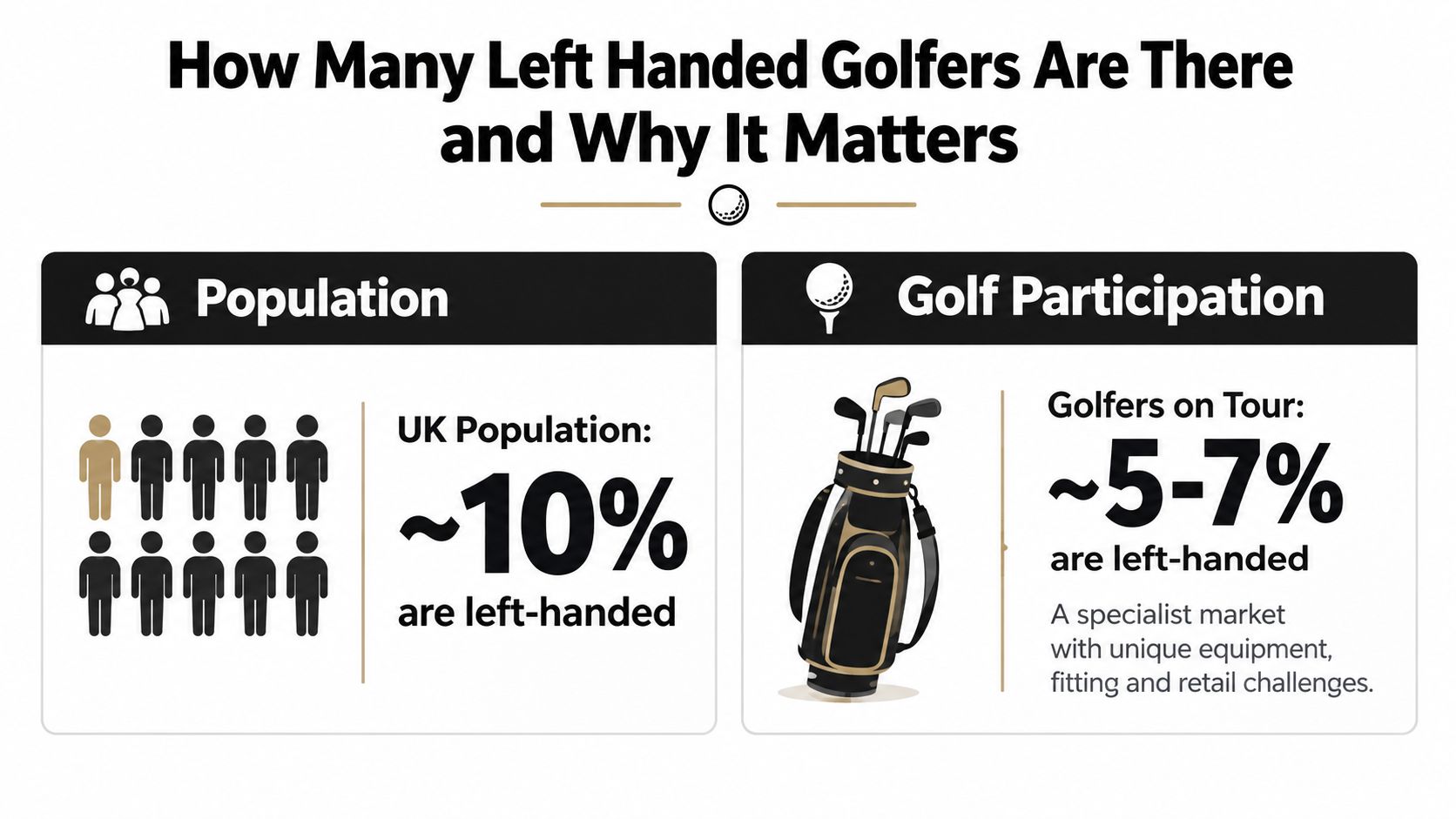
A useful way to think about it is this. If one in every eight or so people is left-handed, that still doesn't mean one in eight golfers in every pro shop wants left-handed clubs. Golf has its own participation pattern, and the buying floor reflects that. BBC golf coverage has long placed the left-handed share of golfers at around 10%, which reinforces the point that left-handed play has stayed a minority for decades, even before you look at newer UK estimates.
What the numbers mean in real shops
That mismatch helps explain why left-handed equipment often feels like a special order, even when a retailer technically carries it. Right-handed golfers can compare more lofts, more shaft options and more head shapes in person. Left-handed shoppers are more likely to find one or two demo heads, then be told to order the rest. The same data also helps explain why dedicated handedness filters exist on retail sites, they're not a gimmick, they're a response to limited inventory depth.
It's also worth remembering that the UK sits above the global average for left-handed golfers, so the British market is relatively better served than some others. That doesn't remove the friction, it just means the selection is a bit more mature than it used to be. The practical takeaway is to search with UK sources first, expect some variation between categories, and assume you may need a fitting or an order rather than a rack-ready purchase.
Practical rule: if you're left-handed, plan around uneven stock instead of hoping the exact club is on the shelf.
What Makes Left Handed Golf Clubs Different
Left-handed clubs are mirror images of right-handed ones, but that mirror matters. The head sits the opposite way, the face points the opposite way, and the geometry has to suit a left-handed setup from address to impact. A left-handed seven iron isn't a right-handed seven iron with a different grip, it's a purpose-built head, with its own lie, loft and orientation.
The parts that actually change
The easiest way to picture it is a door hinge. The door still opens and closes, but the hinge sits on the other side, so the swing path and reference points are reversed. In golf, that reversal affects how the club sits on the turf, how it returns through impact, and how the ball starts off the face. Left-handed players need the clubhead, loft and lie to match that mirror image, otherwise the club may look right in the hand but behave wrong at impact.
UK fitters stress that the same launch-monitor variables matter for lefties and righties, but the fitting process has to include left-handed heads and loft and lie verification. Specialist fitters report measuring length, lie, loft, shaft profile and swing weight, then confirming the result with launch data, because a club that looks “standard” on paper may still be wrong for the player's delivery. Clubhouse Golf's left-handed fitting guidance is a good reminder that the spec check matters as much as the club name.
What to check across the bag
Drivers and fairway woods are usually the easiest left-handed categories to understand, because the main question is loft and shaft. Irons and wedges are where lie angle and length become more important, since they influence how the face sits at impact. Putters matter too, because left-handed golfers still need a head shape and alignment style that fits the stroke, not just the dominant hand.
Practical rule: if the listing doesn't clearly state the club is left-handed, or it hides the spec in tiny print, treat it as a warning sign.
Before you buy, scan every listing for the handedness, loft, lie and shaft details. If you can't see those details, ask for them. Left-handed choice tends to be narrowest in the more specialised shapes, such as certain wedge grinds and some putter neck styles, so the smaller the niche, the more careful the check needs to be. A club that's close is still wrong if the head orientation or lie angle doesn't suit your setup.
Finding Left Handed Golf Clubs Without Overpaying
Buying left-handed gear in the UK usually comes down to three routes, new, used, or mixed. Each one works, but each one solves a different problem. New clubs give you the cleanest spec order, used clubs can stretch a budget, and mixed bags let you build around the clubs you trust most rather than forcing a full set all at once.
Independent UK retailers often frame left-handed buying as a specialist search, while bigger stockists point out that left-handed options exist across drivers, woods, hybrids, irons, wedges and putters, but usually through custom fitting or specialist stores rather than simple browsing. That's a useful clue, because it tells you where the friction sits. The problem isn't that left-handed clubs don't exist, it's that the route to the right one is less direct.
Smart Ways to Build a Left Handed Bag in the UK
| Strategy | Best For | Trade Off |
|---|---|---|
| Buying new | Golfers who want exact specs, juniors needing the right size, and anyone investing in a first proper fitted set | Less room to save money, and left-handed stock can still be uneven |
| Buying used or clearance | Beginners, returners, and golfers who want value while they learn their preferences | Condition varies, spec details can be incomplete, and fit can be off |
| Mixed bag build | Shoppers who want to prioritise a driver, putter or irons first, then fill gaps later | The bag may take longer to finish, and loft gaps need more attention |
If you want a starting point for browsing left-handed categories, you can check Fayrway's left-handed selection. Use that sort of filtered search as a shortcut, not as the whole plan.
How to choose the right route
If you're brand new, a used or mixed route often makes sense because it reduces pressure while you learn what ball flight and head shape you prefer. If you already know your specs, new gear becomes more attractive because you can order around the fit instead of compromising. Juniors and smaller golfers need careful attention to length and control, so buying just because a club is available is a bad shortcut.
Practical rule: choose the route that matches your biggest constraint, not the route that sounds neatest on paper.
A smart used buy can be a very good answer when left-handed new stock is thin, especially if the face, shaft and lie are all clear. A smart mixed bag can also be fine, particularly when you're replacing one club at a time. The mistake is trying to force every purchase into a full-set mindset when your real need is only one or two clubs that behave properly.
Getting Fitted as a Left Handed Golfer
A proper fitting is still the cleanest way to stop guessing, especially if you're left-handed and your local shop has limited demo coverage. The physics don't change for lefties, but the stock does. That means the fitter has to work with the correct left-handed heads and confirm the spec rather than assuming a right-handed demo tells the full story.
What a fitter is actually checking
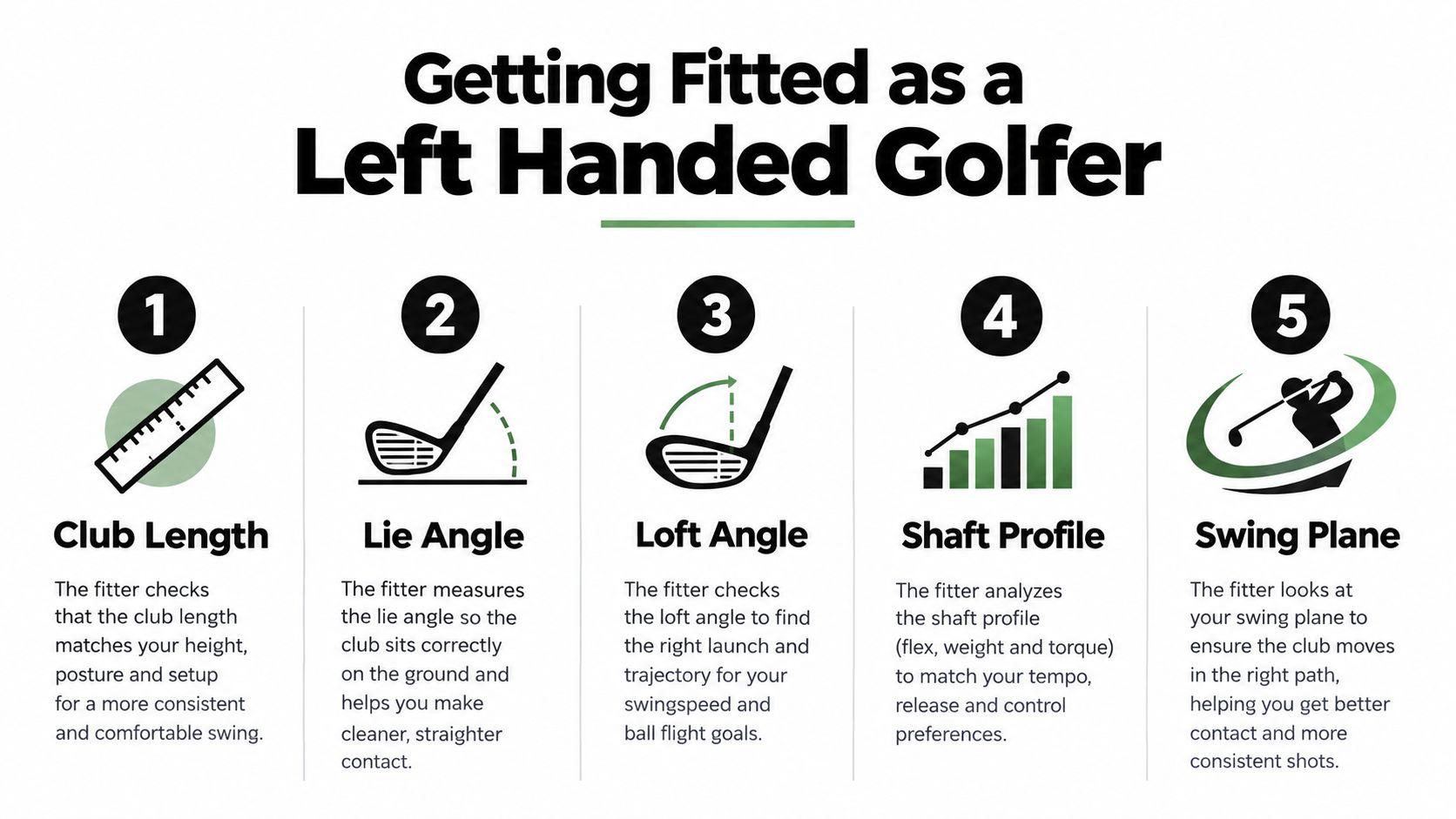
Specialist UK fitters state that they measure length, lie, loft, shaft profile and swing weight, then verify the result with launch data. That matters because a club can feel fine in the hand but still send the ball in the wrong start direction or fail to launch properly. Left-handed players need the same numbers as right-handed players, but the head orientation and demo supply have to be correct first.
Here's the simplest way to think about the five variables. Length controls posture and reach. Lie controls how the sole sits and how the face points at impact. Loft affects launch. Shaft profile affects how the club loads through the swing. Swing weight affects the feel of the clubhead during motion.
How to prepare for a fitting
Bring the clubs you already use, even if they're old or mismatched. Tell the fitter what the ball does, not just what you think the swing looks like. If you tend to miss left, right, high or low, say so clearly. That gives the fitter a place to start, and it helps them choose the right left-handed head instead of improvising with the closest model on hand.
You'll also get better results if you ask the fitter about left-handed head availability before you book. If there's no demo head, the session can still be useful, but the order may need to be built from the data rather than from a wide in-store trial. That's especially important in the UK, where left-handed options can be present in the system but thin on the rack.
Practical rule: a fitting isn't about trying every club. It's about confirming the spec that makes one club behave correctly.
If you're choosing a driver, this guide on driver loft and settings is a sensible companion read after the fitting, because loft and setup are often the easiest changes to get wrong. A good session doesn't just pick a model, it narrows the spec so you can buy with confidence instead of testing your patience.
Learning Resources and Training Aids That Work Left Handed
A left-handed golfer in the UK often runs into a simple problem. The right tool is on the shelf, but the left-handed version is thinner on the ground, and some shops stock only one side of the story. That makes training aids worth a closer look, because many of them work by setting a target, checking the line, or showing club path. Those jobs do not change with handedness if the setup is clear.
Training tools that stay useful
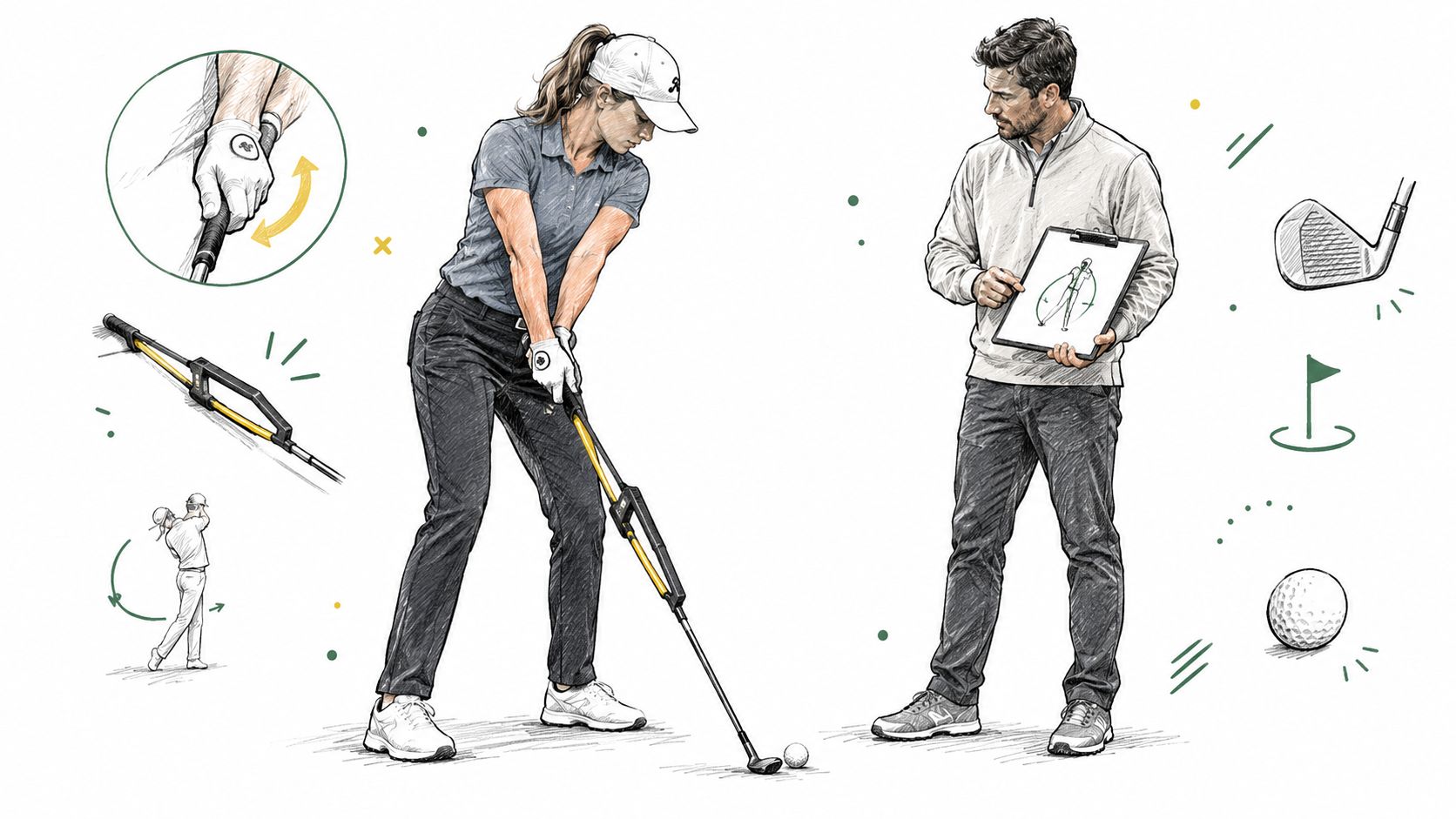
The Swing Plate golf swing trainer with alignment stick is a good fit for that kind of work. It gives you a clear reference point for path, aim and setup, much like laying a ruler beside a drawing before you start the line. Because the system is built around positioning rather than handedness, a left-handed player can use it without needing a separate version for every drill. You can use the same aid at home or on the range, which matters in the UK, where the shop choice can be uneven and you may want one tool that does more than one job.
The SwingPlate Putting Gate works on the same principle. Putting depends on where the ball starts, so the useful part is the feedback, not which side you stand on. Set it up carefully, and it will show whether your stroke is starting on line or drifting away from target.
How to use aids without overcomplicating practice
Short sessions usually do more good than long ones filled with guesses. Ten focused minutes on path, start line or setup gives you cleaner feedback than an hour of unfocused repetition, especially if you are still learning how a left-handed stance changes your eye line and alignment. Keep the goal narrow, and change only one thing at a time.
Use the aid to answer one question. Is the club travelling too far inside? Is the putter face starting left? Is your body line drifting when you set up from the left side? A training aid should make that answer obvious, so you can adjust with purpose instead of guessing.
A simple weekly pattern
A simple routine keeps practice tidy.
- One alignment session: check stance, ball position and shoulder line with a mirror, stick or gate.
- One swing-path block: use the pole or an alignment stick to watch the takeaway and return.
- One putting block: roll short putts through a gate so the start line is clear.
- One review note: write down what changed, so the next session starts with something specific.
Practical rule: use the aid to make one thing obvious, then stop before practice turns messy.
If you already work with a coach, tell them which drills you can repeat at home. That lets them build lessons around a tool that suits your left-handed setup and your routine, rather than assuming the same drill works for everyone. For a left-handed golfer, that kind of consistency is more useful than a bag full of gadgets.
Your Next Steps to Confident Left Handed Golf
The cleanest plan is simple. Start by filtering for handedness, then check the spec, then decide whether new, used or mixed gear fits your budget and urgency. If the club needs to match your body and swing more precisely, book a fitting before you buy. If you're still learning, choose forgiving shapes and leave room to adjust later.
A left-handed golfer in the UK doesn't need a giant shopping list. You need a clear path through a market that's narrower than the right-handed one, but still workable once you know where the friction sits. That means paying attention to availability, fit, and value, in that order.
Before you click buy, use this final filter:
- Confirm the handedness first.
- Read the loft, lie, length and shaft details.
- Decide whether new, used or mixed makes more sense for this club.
- Plan one simple practice drill for the first week.
If you want a curated route through left-handed clubs, training aids and UK support, Fayrway keeps the selection focused and pro-tested rather than endless. Visit Fayrway to compare left-handed options, check the practical specs, and build a bag that matches how you play.


