
Buying Guides
Golf Clubs Wedges Guide: Types, Lofts and Gapping
Sandy Grewal · 24 November 2026
Table of Contents

More spin isn't what rescues a wedge shot from a wet British lie, and the club that transformed short-game play won because of its sole, not its face. The history of the golf wedge records the R&A banning concave-faced wedges in 1931, after which Gene Sarazen built a wider-soled sand wedge with added bounce and won the 1932 British Open with a 283 total. Shortlist golf clubs wedges by loft and bounce, then settle the final lineup with measured carries on the turf you play.
Wedge Types, Lofts and Bounce at a Glance
A complete UK bag usually holds four scoring clubs: a pitching wedge, a gap wedge, a sand wedge and a lob wedge, each with a loft and bounce suited to one job. The starting point isn't the wedge you're thinking of buying. It's the pitching wedge already in the bag.
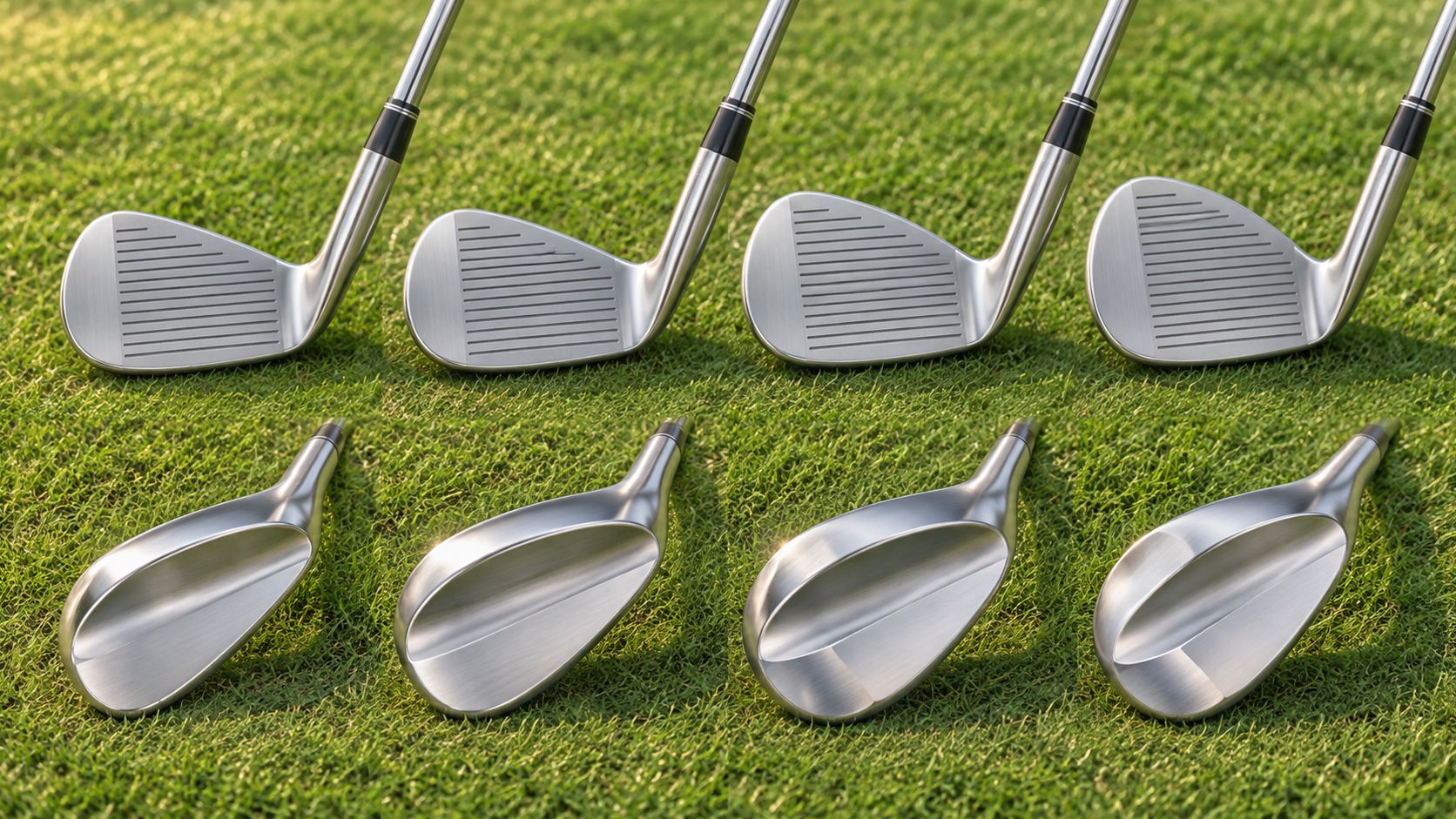
Wedge types, typical loft and bounce
| Wedge | Typical loft | Typical bounce | Main job |
|---|---|---|---|
| Pitching wedge | 41-48° | 4-8° | Full approaches and firm-lie scoring shots |
| Gap wedge | 50-52° | 6-10° | Filling the distance between pitching and sand wedge |
| Sand wedge | 54-56° | 10-14° | Bunkers and soft lies around the green |
| Lob wedge | 58-64° | 4-10° | High, soft shots over short distances from good lies |
That pitching-wedge window is wide for a reason. Published fitting data in a UK wedge buyer's guide shows examples ranging from 41° to 48° across player, distance and game-improvement categories, so the number stamped on the sole matters far more than the word "pitching".
Bounce is the angle between the leading edge and the ground at address. More bounce lets the sole slide through sand and soft turf. Less bounce lets the leading edge sit under the ball on firm, tight lies.
Three rules cover most buying decisions:
- Read the sole, not the label: two clubs marked "gap wedge" can sit several degrees apart, and only one of them fills your gap.
- Treat bounce as the deciding spec for bunkers: loft gets the ball up, bounce stops the club burying itself in wet sand.
- Only carry a lob wedge if you can strike it from a good lie: it's the least forgiving club in the bag from a bare, tight fairway.
Practical rule: write down the loft of your pitching wedge before spending anything. Every other wedge choice follows from that number.
How Turf, Bounce and Sole Grind Change Wedge Shots
The R&A's investigation into ball-turf impact characteristics found sand-wedge shots produced substantially shorter bounce-and-roll outcomes than driver and 5-iron shots across tested turf sites, and several sand-wedge and venue combinations recorded negative bounce or roll, meaning the ball spun back towards the impact point. The same work showed turf type and ball-cover material influence the result. Ground conditions aren't a footnote to wedge performance. They're half of it.

Sole grind is a strike question, not a fashion choice
Grind describes the shape of the sole, particularly the material removed at the heel and toe. That relief decides where the leading edge sits when you open the face for a flop or close it for a low runner. A deep-divot taker on soft parkland wants more bounce and a fuller sole so the club rides through the turf. A sweeper on firm links turf wants less bounce and more relief, otherwise the sole skips into the back of the ball.
Brand grind letters are shorthand for those shapes. Vokey's S, F, M and L grinds are worth checking on the spec sheet rather than assuming, because the same loft can come in several soles.
Matching bounce and sole to UK turf and lies
| Lie or condition | Bounce and sole | What it does | Example club |
|---|---|---|---|
| Soft winter fairway or muddy rough | 10-14° bounce, wider sole | Slides rather than digs through soft turf | Sand wedge |
| Firm links turf or tight dry lie | 4-8° bounce, heel and toe relief | Lets the leading edge sit close to the ball | Lob wedge or gap wedge |
| Wet sand or soft bunker | 10-14° bounce, wide sole | Uses the sand to stop the club digging | Sand wedge |
| Deep divots on soft parkland | More bounce, S or F grind | Prevents the leading edge from digging | Sand wedge or gap wedge |
| Shallow sweeping strike on firm turf | Less bounce, M or L grind | Keeps the sole from bouncing into the ball | Lob wedge |
Why aggressive grooves can't beat a wet lie
Moisture changes the physics of contact. Independent STRI research on wet-weather play explains that moisture reduces friction, so the ball leaves the clubface faster while generating less spin, and grooves help move water away from the impact area. Spin is also lower from rough than from the fairway. Grass and water between ball and face dominate what the grooves can do.
UK-based controlled testing published in the Golf Science Journal found sand-wedge spin was affected independently and significantly by both groove design and playing surface, reporting F1 = 877.18, p <.01 for groove effects and F1 = 872.38, p <.01 for surface effects. Two separate levers, and only one of them is in your bag.
Buying a more aggressively grooved wedge won't fix a muddy lie. It changes one variable while the wet one stays exactly where it was.
The working habits follow from that. Wipe the face and the ball before every greenside shot, keep a dry towel in a pocket that isn't already soaked, and expect dew-covered morning greens to give you rollout you didn't plan for. From wet rough, take one more club and swing smoother rather than trying to dig the ball out with extra speed.
One test that settles the argument
- Pick three real lies at your club: a damp fairway, a soft greenside rough patch and a bunker. Hit five shots from each with your candidate wedge and note where the ball lands and where it stops.
- Repeat the same test on your home course a week later, ideally after rain rather than on a dry afternoon.
- Keep the sole that gives you the most repeatable carry and rollout, not the one that produced a single highlight-reel check-up.
Dry-mat launch-monitor numbers are a starting reference. They aren't a prediction of what happens on a February fairway.
Building Wedge Gapping That Covers Your Distances
Start with the pitching wedge loft you wrote down, because it sets the whole progression. The familiar advice of 4-6° of loft spacing and 10-15 yards of carry is a sensible starting pattern, not a rule, and a club labelled "gap" or "lob" tells you nothing about the carry you'll produce.
There's a hard constraint sitting behind all of this. The evolution of the golf club records the R&A introducing the 14-club limit in 1939, at a time when carrying 20 to 30 clubs was common. Every wedge you add displaces something else, so each one has to earn its slot.

Wedge gapping diagnosis
| Pairing | Typical loft gap | Target carry gap | Warning sign | First action |
|---|---|---|---|---|
| Pitching wedge to gap wedge | 4-6° | 10-15 yards | Full-swing carries less than 8 yards apart | Check the pitching wedge loft on the sole and test a stronger or weaker gap wedge |
| Gap wedge to sand wedge | 4-6° | 10-15 yards | Sand wedge carrying the same as the gap wedge | Measure three swing lengths and drop or adjust the duplicate |
| Sand wedge to lob wedge | 4-6° | 10-15 yards | Lob wedge used only from the bunker edge | Keep it only if it covers a real carry gap or a repeatable short-side shot |
The carry test
- Note the pitching wedge loft from the sole.
- Hit ten full, ten three-quarter and ten half swings with each wedge, using the same ball model you play.
- Average the carry for each swing length, discarding obvious mishits rather than the whole set.
- Find the largest hole in the ladder, anything over about 15 yards.
- Add one wedge to fill it, or drop the one that duplicates another.
- Retest after four weeks of play, because your partial swings will change.
If you're building the yardage ladder for the rest of the bag at the same time, the Journal's guide to golf club distances explained is the companion piece.
Beginners and slower swingers usually gain more from fewer, easier wedges plus one repeatable partial swing than from a fourth specialist club they can't yet control.
Choosing Wedge Shafts, Flex and Lie
Wedge shafts are where fitting earns its money, because a mismatch shows up as distance control rather than as an obvious bad shot.
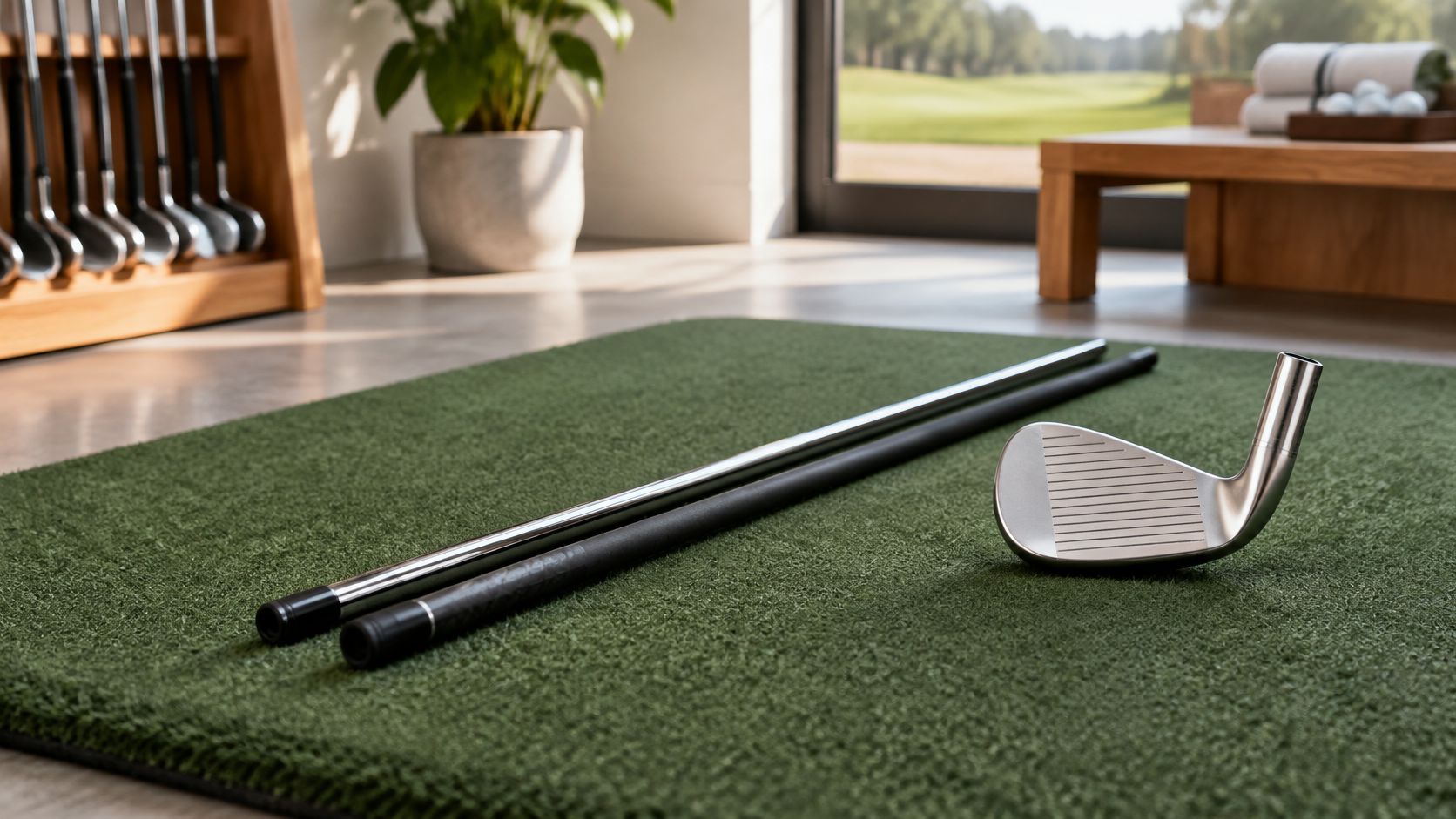
Steel or graphite
Say a spec sheet offers a heavy steel wedge shaft and a much lighter graphite alternative. The heavier steel option gives most players a steadier face through impact and a firmer feel, which is what you want when you're trying to land the ball on a number. The lighter graphite build suits slower swing speeds and golfers who find heavy steel tiring over 18 holes, at the cost of some feedback.
Flex normally follows the iron set. Faster swingers sometimes go one step stiffer in wedges to keep the flight down on partial shots, while slower swingers can go one step softer. Standard wedge length sits around 35 to 36 inches, and shorter players often do better slightly under that, because posture and strike improve before distance ever does. The Journal's piece on stiff or regular flex shafts covers how to read your own tempo.
Lie angle decides whether the toe sits up at address. Too upright and most right-handed players pull the ball left. Too flat and it starts right.
Get the setup finished before the first tee
The R&A's club playing rules make clear that under Rule 4.1 a golfer can't deliberately alter a club's performance characteristics during a round, including changing an adjustable setting or modifying loft, lie, weight distribution, head or shaft, with a flatter lie or greater loft given as examples. Applying a substance to the clubhead to affect performance is also prohibited, although ordinary cleaning is allowed.
Take this checklist to a fitting:
- Strike pattern: where the ball marks the face, low or towards the toe.
- Divot depth: deep and directional, or shallow and swept.
- Length and lie: checked at address in your normal posture, not standing upright.
- Partial-swing carries: measured, not guessed.
Groove Specifications and Worn Grooves
Grooves are regulated, which is why "maximum spin" claims deserve scepticism. For wedges and other clubs with a loft of 25 degrees or more, the R&A's conformance of clubs rules limit groove width to 0.035 inches (0.9 mm) and groove depth to 0.020 inches (0.508 mm), and require grooves to be straight, parallel, symmetrical in cross-section and consistent across the impact area.
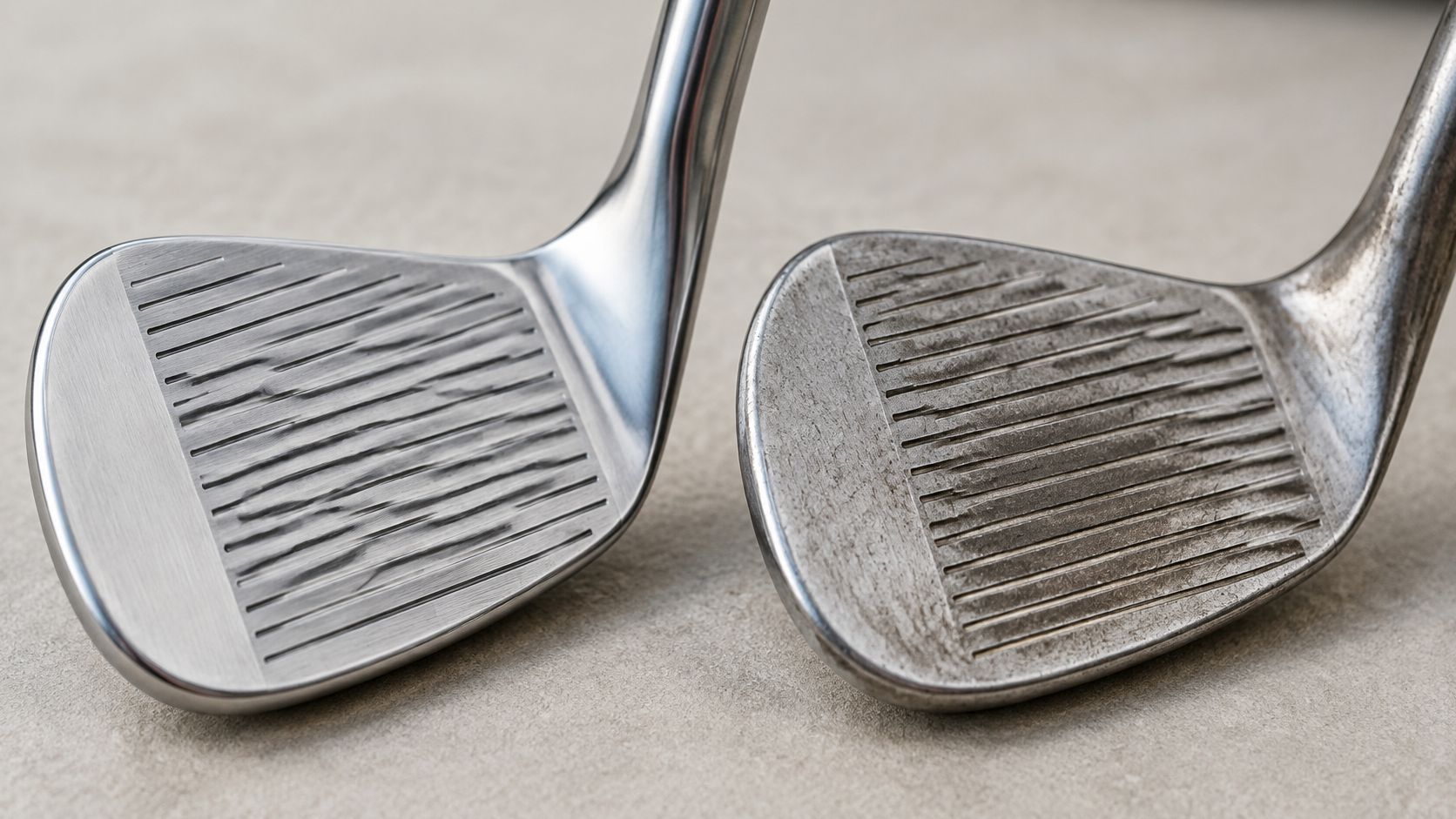
R&A groove limits for wedges and lofted clubs
| Feature | Limit | What to check |
|---|---|---|
| Groove width | 0.035 in (0.9 mm) | Look for over-wide or re-cut grooves on second-hand wedges |
| Groove depth | 0.020 in (0.508 mm) | Deep aggressive grooves can fall outside the Equipment Rules |
| Groove edge radius | 0.010 in (0.254 mm) minimum | Sharp edges from wear or modification aren't automatically better |
| Cross-sectional area divided by pitch | 0.0030 sq in per in (0.0762 sq mm per mm) | Check the model in the R&A groove database if unsure |
| Groove shape | Straight, parallel, symmetrical, plain walls | Reject deliberately inconsistent or non-standard grooves |
The edge radius and area figures come from the R&A's 2010 club face markings paper, which also requires plain groove walls and prohibits deliberate inconsistencies designed to influence ball movement.
Reading wear at home
Years of sand, practice mats and abrasive scrubbing round the groove edges over, and spin drops while the loft stays exactly the same. Run a fingernail across the grooves: a crisp edge catches, a worn one feels smooth. Hold the face under a light and look for rounding, then compare with a new wedge of the same model if you can.
Clean with warm water, a soft nylon brush and a towel, working along the groove lines rather than across them. The Journal's golf club cleaning kit guide lists what's worth owning. Ordinary cleaning is fine. Anything that alters the face to change performance isn't.
Set Your Wedge Lineup Before Your Next Round
Three sensible lineups, by ability:
- Beginners and higher handicaps: pitching wedge, sand wedge and one gap or lob wedge, chosen for easy repeatable partial shots rather than shot-shaping.
- Mid handicaps: add a gap wedge for clean full-shot spacing, and keep the lob wedge only if it covers a shot you play most weeks.
- Low handicaps: four wedges are justified, but only when every gap has been measured on grass.
Older wedges aren't automatically illegal for ordinary club golf. The R&A's equipment information for players states that clubs available before 1 January 2010 which complied with the 2009 Rules may continue to be used under the Rules of Golf unless a Committee introduces Model Local Rule G-2 requiring the newer groove specifications, with the updated requirements applying to new models manufactured from 1 January 2010. Check the exact model in the R&A groove database rather than judging by age or how aggressive the face looks.
Where you practise matters too. Mats flatter a low-bounce sole and hide the digging you'd see on a damp fairway, so it's worth reading PSW Events' comparison of indoor golf or outdoor range practice before deciding where to run your carry test. Grass tells the truth about bounce.
The Fayrway golf clubs range is divided into Drivers, Fairway Woods, Hybrids, Irons, Wedges, Putters and Package Sets, so the wedges collection is the natural place to shop a lineup you've already specified.
Order of operations: write down the pitching wedge loft, run the carry test, check the groove model, then buy the one wedge that fills the largest gap.
Frequently asked questions
How many wedges should I carry?
Most golfers do well with three. Four only when every gap has been measured and each club covers a shot you play regularly, otherwise you're carrying a duplicate.
What loft is a sand wedge?
Typically 54 to 56 degrees, with 10 to 14 degrees of bounce for bunkers and soft lies. Bounce is the spec that decides whether the club escapes wet sand or buries itself.
Can I bend my wedge to change the loft?
Not during a round. Rule 4.1 prohibits deliberately altering loft, lie or shaft while playing, so have a fitter make changes beforehand and retest your carries afterwards.
Are pre-2010 wedges legal for club golf?
Usually yes, unless a competition committee adopts the local rule requiring the newer groove specification. Check the specific model in the R&A groove database rather than relying on its age.
Should I use a graphite or steel shaft?
Steel suits most players for control and feel through the strike. Graphite can suit slower swingers who want less weight, and watching how tour players manage wedge flight on a Sunday, whether at the course or via Fubo News' guide to how to watch the final round of the CME Group Tour Championship, shows how much of short-game scoring is trajectory control rather than raw spin.
Fayrway's pros curate a deliberately short wedge range with suitability notes on each pick, so you can match loft, bounce and sole to the lies you play most rather than guessing from a spin claim. Bring your pitching wedge loft and your measured carries to the Fayrway site and shortlist the one wedge that fills your biggest gap. Free UK delivery over £50 and 30-day returns mean you can test it on your own turf, in your own weather, before committing.


