
Comparisons
Blade vs Mallet Putters: Which One Suits Your Game
Sandy Grewal · 10 November 2026
Table of Contents
- Blade and Mallet Putters Side by Side
- What Stability and MOI Change on Off-Centre Hits
- Short Putts and Three-Putts in the Amateur Data
- Matching Your Miss and Stroke to a Head Shape
- Alignment Aids and Setting Up at Address
- How to Test Both Designs on a Practice Green
- Which Putter Suits Your Game and How to Check the Fit
- Frequently asked questions

The most popular advice in the blade vs mallet putters debate, buy a mallet because it's more forgiving, is lazy advice. Forgiving of what, exactly? A head that protects ball speed on a heel strike won't fix poor aim, and a head that helps aim won't fix a decelerating stroke. The right choice starts with the miss that costs shots, not with the head that wins on tour or looks best in the shop.
Blade and Mallet Putters Side by Side
A blade is a thin, compact head that usually suits a golfer with a noticeable arc in the stroke. A mallet is a larger head with weight pushed to the perimeter and back, built to resist twisting and suit a straighter stroke. That's the short answer, and it already points to the test: stroke shape and miss pattern rather than fashion.
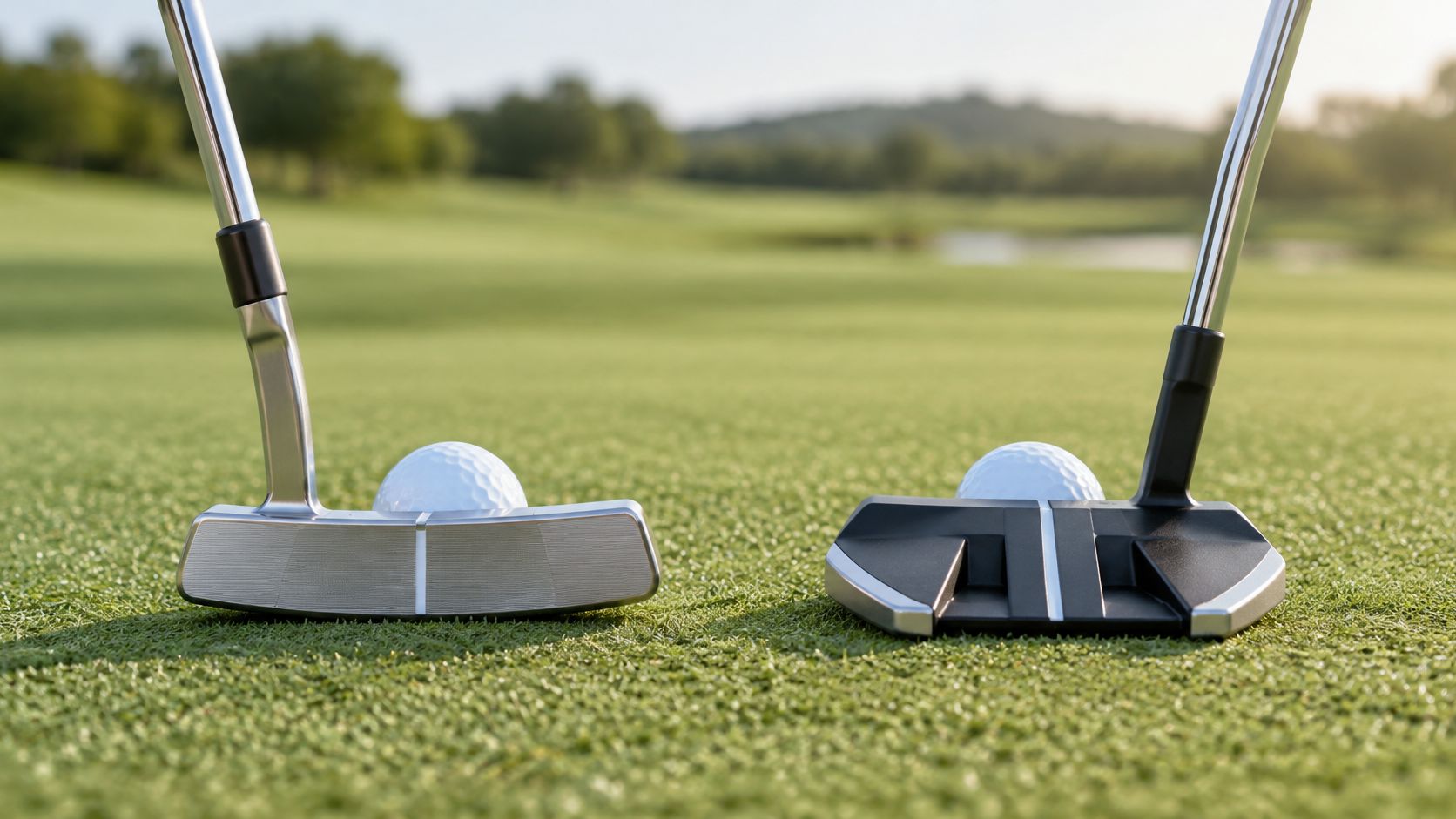
| Feature | Blade | Mallet |
|---|---|---|
| Typical head shape | Compact, often toe-weighted | Larger head, weight pushed to the perimeter and back |
| Moment of inertia (MOI) | Lower | Higher |
| Face balance and stroke fit | Usually toe hang, suits an arcing stroke | Often face-balanced, suits a straighter stroke |
| Face rotation on off-centre strikes | More rotation | Less rotation |
| Alignment aids | Usually minimal | Often sightlines or alignment lines |
| UK market share, 2024 estimate | 40% | 60% |
| PGA Tour winners, 2025 | 20% | 80% |
Two figures explain why mallets feel unavoidable right now. Credence Research's 2024 UK putter market assessment estimated mallet putters at 60% of market share, leaving blades with 40%. At tour level, Bunkered's comparison of PGA Tour winners found blade putters were used by 60% of the winners in 2015, while by the 2025 season mallet putters were used by 80% of winners and blades by only 20%.
Neither figure proves a mallet lowers scores. Market share measures what golfers buy, and tour usage reflects fitting, stroke mechanics and sponsorship as well as performance. They show popularity and nothing more.
Popularity settles what's normal, not what suits a particular stroke.
Read the table as a description of what each design does. The sections that follow matter because they match those differences to the misses that show up on a scorecard.
What Stability and MOI Change on Off-Centre Hits
Moment of inertia, or MOI, describes how strongly the head resists rotating when the strike lands away from the sweet spot. It's not a measure of intrinsic accuracy. A centred strike from a well-aimed blade rolls just as well as one from a mallet, and no amount of MOI corrects a putter aimed left of the hole.

How each head handles a mishit
Golf Monthly's UK technical coverage of putter design explains that a blade typically uses more toe-oriented weighting and greater toe hang, encouraging face rotation, while a mallet positions more mass toward the perimeter and rear, increasing MOI and reducing head twisting on off-centre impact. In practice, that means a mallet tends to preserve ball speed better on a heel or toe strike. The same miss with a blade twists the face more, so speed drops faster.
Most guides stop there and declare the mallet more forgiving. That skips a genuine trade-off. A blade's centre of mass sits closer to the face, so a mishit can deflect less offline even though it loses speed. On a short putt, where the ball reaches the hole anyway and a small directional error decides everything, losing line can cost more than losing pace.
A 10-foot putt caught toward the heel
Say a golfer strikes a 10-foot putt slightly toward the heel on a flat green. With a low-MOI blade, the face twists, speed bleeds away, and the ball dies short and to one side. With a high-MOI mallet, speed holds up better and the ball reaches the hole, but if the face was already a fraction open at impact, that extra speed carries the error past the edge. One golfer's problem is pace loss, the other's is start line, and the same putt produces two different failures.
That distinction decides which trade-off to accept. Golfers whose mishits mainly finish short benefit most from speed retention. Golfers whose mishits mainly start offline need face control first, and a bigger head treats the wrong problem.
Short Putts and Three-Putts in the Amateur Data
Amateur evidence for this comparison is thin, so one benchmark carries a lot of weight and deserves a careful reading. Golf Monthly's UK golf-performance dataset found that among average 15-handicap golfers, putts holed from six feet and inside increased from 75% with a blade to 82% with a mallet, while average three-putts fell from 2.6 to 2.3 per round.
| Measure (average 15-handicap golfers) | Blade | Mallet |
|---|---|---|
| Putts holed from six feet and inside | 75% | 82% |
| Average three-putts per round | 2.6 | 2.3 |
The three-putt gap deserves more attention than the holing rate. A difference of 0.3 three-putts per round adds up to roughly three fewer three-putts every ten rounds. For most club golfers, removing three wasted shots across ten cards matters more than the occasional extra six-footer that drops.
What those figures cannot show
The dataset doesn't prove head shape caused either gap. Golfers who switch putters often change stroke habits, practise more for a few weeks, or get fitted at the same time, and any of those could explain part of the improvement. The figures also say nothing about lag putting, green speed, lie angle or putter length, all of which shape outcomes round after round.
Treat the numbers as a benchmark, not a guarantee. A scorecard littered with three-putts and missed short ones makes a mallet a sensible test. A scorecard where the first putt routinely finishes six feet past has a pace problem, and these figures have little to say about it.
Which number on the card needs to move? That question points to the right head faster than any general claim about forgiveness.
Matching Your Miss and Stroke to a Head Shape
Start with one rule. Identify the miss that costs the most shots, then choose the head that addresses it. Choosing by category first, mallet because mallets are forgiving or blade because blades look proper, puts the decision in the wrong order.

| Typical miss | Likely priority | Head to try first | What to watch for |
|---|---|---|---|
| Putts miss offline on a square face | Start-line control | Compact blade or face-balanced mallet | Confirm the start line during the test |
| Putts finish short on fast greens | Speed retention on off-centre strikes | Higher-MOI mallet | Heel and toe strikes lose speed fastest |
| Face twists through a straight stroke | Less face rotation | Face-balanced mallet | Check the face stays square through impact |
| Strong arc with the face opening and closing | Matching a natural arc | Blade with toe hang | Check the arc stays consistent on longer putts |
| Aim feels uncertain at address | Alignment | Mallet with sightlines | Alignment lines help only with a square setup |
| Three-putts from long range | Distance control | Test both heads, then work on pace | Head shape will not fix pace |
The stroke test sits underneath every row. A strong arc, where the head travels inside the line and the face opens and closes, usually suits a toe-hang blade that rotates with it. A straighter back-and-through stroke with a face that stays square usually suits a face-balanced mallet that doesn't ask for rotation the golfer isn't supplying.
Plenty of golfers sit between the two. A compact mallet adds perimeter weight without an oversized footprint, and a face-balanced blade keeps a traditional look with less rotation. Neither compromise is a cop-out when the stroke is moderate.
British conditions sharpen the choice further. On slow, wet winter greens, putts need a firmer hit and speed retention on off-centre strikes earns its keep. On fast summer greens, small face errors show up sooner and start-line control becomes the priority.
Practical rule: note the last ten putting misses, group them as short, long or offline, and match the biggest group to a row in the table.
Alignment Aids and Setting Up at Address
Mallets often carry sightlines, rails or bars because the larger head gives designers room to draw on. Blades typically carry a single line, a dot or nothing at all. Neither approach aims the putter on its own, and the honest position is that the setup routine matters more than the line printed on the head.
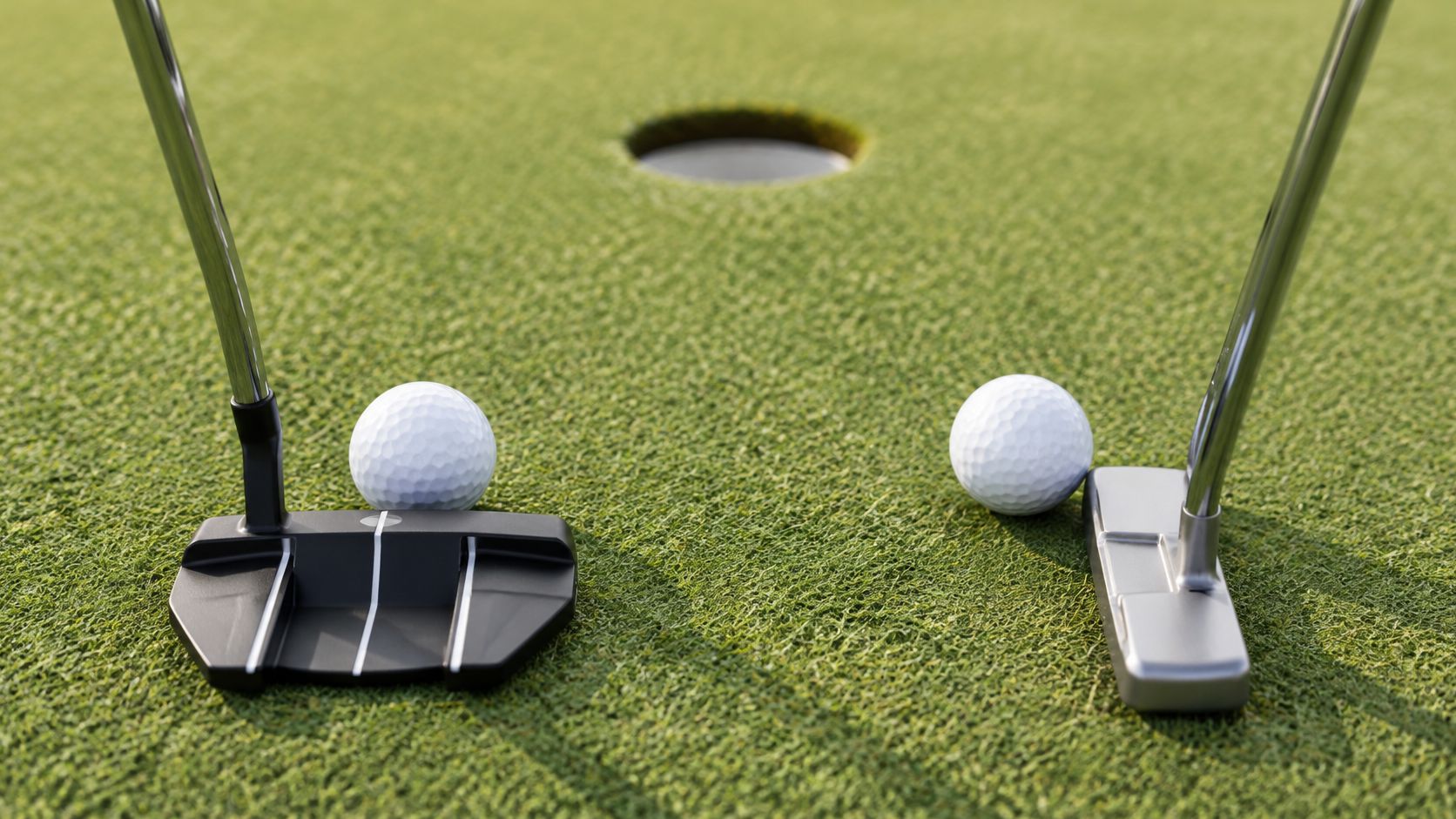
Alignment features only help when the eyes sit over the ball and the feet are set to the target line. A golfer standing open to the target will aim a line-covered mallet just as wrongly as a plain blade, only with more confidence. Treat the feature as a check within a routine, built around three checks.
- Eyes over the ball line: confirm from behind with a second player watching, or on video.
- Face square before the grip: set the putter face to the target line first, then take hold without rotating it.
- Same grip pressure every putt: consistent firmness stops the hands steering the face under pressure.
Practice aids by type can verify all three. A putting gate the ball rolls through confirms start line, and an alignment mirror confirms eye position, whatever the head shape. The SwingPlate Putting Gate Precision Golf Training Aid costs £19.99, which keeps that check cheap relative to a new putter. Run the same routine on every putt, and it becomes the most reliable alignment aid in the bag.
How to Test Both Designs on a Practice Green
Half an hour on the practice green ends arguments that months of reading never will. Change only the head. Keep the ball, the grip and the routine identical, or the comparison is worthless.
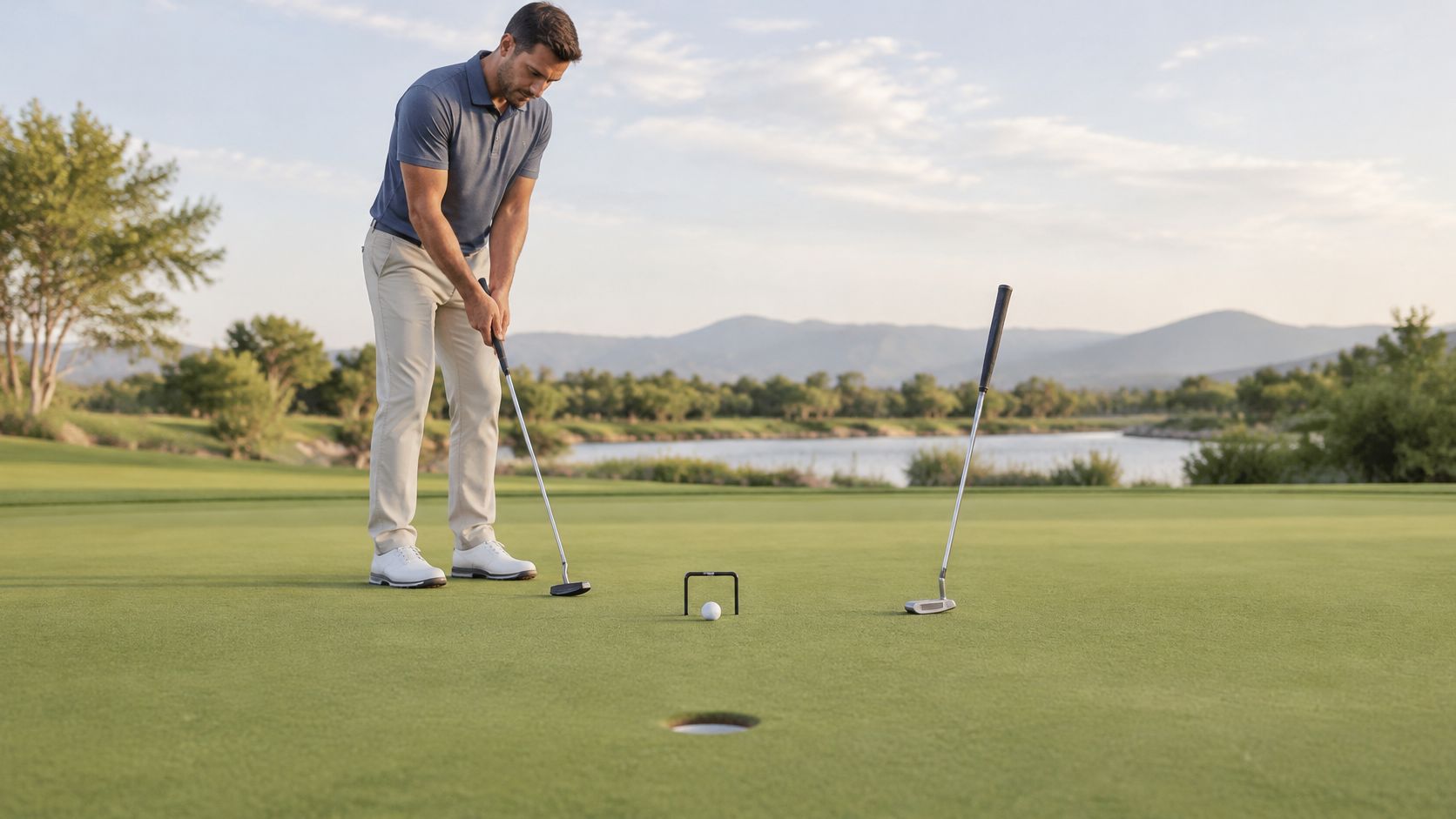
Run both heads through the same seven checks.
- Pick two putts: a flat, straight 10-footer and a 20-footer on a slope, so start line and distance sit in one session.
- Hit ten putts with each head: same ball, grip and routine throughout. A changed setup changes the result.
- Log start line and finish: left, right or on target, and short, at the hole or past it.
- Mark the contact point: dust the face, or use a light marker, so heel, centre and toe strikes show up against the misses.
- Count misses by type: offline, short, long and three-putt chances, not holed putts alone.
- Repeat on a different surface: a faster green, a slower green, or a different time of day. The first result has to survive changed conditions.
- Read the pattern: the better head keeps the start line on toe strikes and holds speed on heel strikes, for this stroke, not for an average golfer.
Pace decides more putts than head shape. On a flat, even surface a putt needs enough speed to catch the hole and not so much that it lips out. That ideal does not transfer to the sloped, damp greens most club golfers play, so the log of short and long finishes matters as much as the log of start lines.
A gate drill isolates the start-line half. The SwingPlate putting gate gives a pass or fail on every roll without changing the head comparison.
The session shows what each head does for this stroke on these greens. A tour stroke on a tour surface is a different problem, and copying that answer rarely carries over.
Which Putter Suits Your Game and How to Check the Fit
Firm recommendations are possible once player type replaces head category as the starting point. Beginners who three-putt often and struggle to aim should start with a mallet carrying clear alignment lines, ideally after a fitting session with a professional. Intermediate players with a repeatable arc and reliable distance feel can choose a blade with a clear conscience, especially if strikes already find the centre. Seasoned golfers should test both designs before changing anything, because a well-fitted putter already in the bag usually beats a switch made for fashion.
Fitting checks apply equally to both designs, and each one can undo a good head choice.
- Length: eyes over the ball and hands relaxed at address.
- Lie: the sole sits flat when the shaft rests naturally.
- Grip size: thick enough that the hands don't twist the face.
- Face balance: balance the shaft on one finger, since a face staying level suits a straighter stroke.
- Head weight: chosen for feel and tempo, not maximum heft.
The Fayrway golf clubs range is divided into Drivers, Fairway Woods, Hybrids, Irons, Wedges, Putters and Package Sets, so putter shopping sits inside a clearly organised range. Browse the Fayrway putters range after running the practice green test, and the shortlist usually writes itself.
Frequently asked questions
Is a mallet more forgiving than a blade
Forgiveness is not one score. If toe and heel strikes are the miss you make, start with What Stability and MOI Change on Off-Centre Hits, then decide whether stability or start-line control is the gap.
Do tour players still use blades
A minority do, and they win with them. That sample is elite strokes and elite fittings, so it should not pick a club golfer's head. If you are building a first bag, the guide to putters for beginners is the more useful place to start.
Should a lifelong blade user switch
Switch only when the practice-green test shows a problem the current head cannot fix. The stroke has to change with the head. Keep the old compensations and the new shape rarely settles.
Is a fitting necessary
Yes, if you cannot name your arc or your usual miss. Those two facts do more work than the category label. Run the checks in Which Putter Suits Your Game and How to Check the Fit before you spend on a different shape.
Are mallets allowed in competition
Putter legality sits under the Rules of Golf, administered by The R&A for golfers in the UK. Ask your home club, or England Golf, about the current rules and any local rules before you enter.
Which design suits fast greens better
Green speed does not award the category to either head. The day before a competition, take both putters to the quickest practice green you can find and run the test in How to Test Both Designs on a Practice Green, scoring pace and start line as separate misses. Take the head that already matches the miss you see. Leave the other in the bag.
Fayrway's pros stock putters with notes that say who each pick suits. Once the practice green has named your miss, use those notes at Fayrway and buy the head that matches the pattern.


