
Buying Guides
Best Golf Clubs for Beginners: What Is Actually in Your First Set
Fayrway Pros · 28 August 2026
Table of Contents
- At a glance: the best beginner golf sets for 2026
- What should actually be in a beginner's first set?
- Why is a complete set the right call for beginners?
- Do you need a fitting, and graphite or steel shafts?
- What about premium irons and tour brands?
- Our top picks in detail
- What we would skip
- Frequently asked questions
- Ready to choose?

For most beginners the smart buy is a complete package set, not clubs bought piece by piece. The Callaway Strata 12-Piece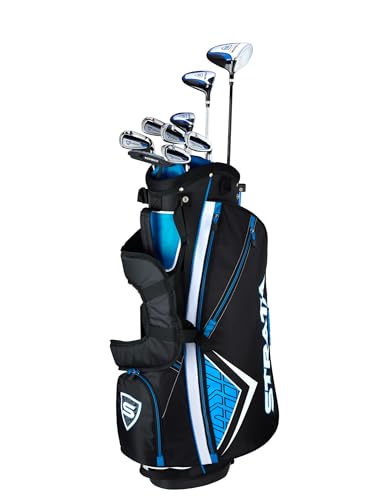 Callaway Strata 12-Piece£329.99Buy on Amazon is the safest all-rounder, the SKYMAX Precise M5
 SKYMAX Precise M5£179.00Buy on Amazon is the best value full set, and the MacGregor DCT4000
 MacGregor DCT4000£249.99Buy on Amazon suits improvers ready for a few more clubs. Save a proper fitting for when your swing settles.
Your first set does not need to be complicated. A complete set gives you every club you need to start, in a matched flex, with a bag, for one sensible price. Below are the best beginner sets you can buy on Amazon right now with fast delivery, grouped by the job they do best, plus honest guidance on what belongs in a first set and when a custom fitting is actually worth it.
At a glance: the best beginner golf sets for 2026
| Set | Pieces | Best for | Price |
|---|---|---|---|
| Callaway Strata 12-Piece Men's | 12 | Best overall set | £329.99 |
| SKYMAX Precise M5 Men's | Full set | Best value set | £179.00 |
| Wilson Ultra HL with Stand Bag | Full set | Best premium set | £399.00 |
| Fazer CTRX Starter Set | Starter kit | Best compact starter set | £149.00 |
| Callaway Strata 11-Piece Women's | 11 | Best ladies set | £320.27 |
| MacGregor DCT4000 13-Piece | 13 | Best for improvers | £249.99 |
Prices are pulled live from Amazon and update through the day.
What should actually be in a beginner's first set?
Fewer clubs than you think, and every one of them forgiving. A good first set covers a driver for the tee, a fairway wood or hybrid for long shots, a run of irons from around a 6-iron down to a pitching wedge, a sand wedge, a putter, and a bag to carry it all. That is enough to play every shot on a golf course without owning fourteen clubs you cannot yet use.
The clubs that help a beginner most are the easy-to-hit ones. Hybrids replace the hard-to-strike long irons, cavity-back irons spread the sweet spot wider, and a lofted, oversized driver gets the ball airborne without a perfect swing. Complete sets are built around exactly these forgiving heads, which is why they suit new golfers so well.
Why is a complete set the right call for beginners?
Because it removes every decision you are not ready to make. A package set arrives matched: the shafts share one flex, the heads share one design language, and the gaps between clubs are set for you, so you are not guessing whether your 4-iron and your driver belong in the same bag. You get a coherent set of forgiving clubs for less than the cost of a single premium driver bought alone.
Building a set club by club is how experienced golfers fine-tune their bag, not how beginners should start. At this stage your swing is still changing week to week, so spending big on individual clubs matched to a swing you do not yet have is money in the wrong place. Play a full season with a complete set, learn what your misses look like, then upgrade the pieces that actually hold you back.
Do you need a fitting, and graphite or steel shafts?
Not for your first set, but yes before you spend big later. A custom fitting matches shaft flex, length, lie angle and grip size to your swing, and it genuinely helps once your motion is repeatable. For a brand-new golfer whose swing speed and path are still settling, a well-chosen complete set in a standard flex is close enough, and far better value.
On shafts, graphite is lighter and easier to swing fast, which helps most beginners and nearly all women and junior golfers get the ball up. Steel is heavier and a touch more consistent for stronger, faster swingers. Many beginner sets pair graphite woods with steel irons to give you the best of both. When you do book a fitting, bring the set you have been playing so the fitter can see your real tendencies.
What about premium irons and tour brands?
They are superb, and one day you may want them. The forged players' irons and adjustable tour drivers from the likes of Titleist, TaylorMade, PING and Mizuno are built for golfers who already strike the ball cleanly and want to shape it, and they are sold fitted through specialist golf retailers rather than as boxed sets. The best modern clubs are almost always bought custom-fitted, not off a shelf, so if you are ready to spend serious money, book a fitting first.
The picks here are not trying to be those clubs. They are the best-value complete sets you can actually buy in stock today, built to get a beginner or improver playing well without overspending on kit a new swing cannot use. When you outgrow your first set and want fitted upgrades, you can see what our pros stock in the Fayrway golf package sets range.
Our top picks in detail
Callaway Strata 12-Piece Men's: best overall set
Verdict: the set we would point most male beginners to first. A trusted golf brand, a genuinely forgiving line-up, and a bag included.
The Strata 12-piece covers everything a new golfer needs: a lofted titanium driver that gets the ball up easily, a fairway wood, a hybrid to replace the awkward long irons, a run of stainless cavity-back irons, a putter and a bag. Callaway is one of the biggest names in golf, and the set is designed around forgiveness rather than workability, which is exactly what a beginner wants. Nothing else here balances brand reassurance, spec and value quite as well.
- Pros: trusted Callaway name, forgiving driver and hybrid, complete with bag, matched throughout.
- Cons: priced above the bargain sets, right-hand men's only in this listing.
Callaway Strata 12-Piece Men's
- Forgiving driver, wood, hybrid and irons
- Trusted Callaway build quality
- Complete with bag and headcovers
Price on Amazon
£329.99
SKYMAX Precise M5 Men's: best value set
Verdict: a full, current-year complete set at a price that leaves room for a season of lessons and balls.
The Precise M5 gives you a proper full line-up, driver, wood, hybrid, irons, wedge, putter and bag, for well under the cost of the big-brand sets. It is not a famous name and the finish is functional rather than plush, but the clubs are forgiving, the flex is matched, and for a golfer who wants to try the game without a large outlay it does the fundamental job. Put the money you save into range time.
- Pros: excellent value, complete full set, current 2026 line-up, matched flex.
- Cons: lesser-known brand, plain finish, resale value is limited.
SKYMAX Precise M5 Men's
- A full set at a starter price
- Forgiving woods, hybrid and irons
- Bag included, matched flex throughout
Price on Amazon
£179.00
Wilson Ultra HL with Stand Bag: best premium set
Verdict: the step up for a beginner who wants a recognised golf brand and a better bag without paying tour prices.
Wilson has made clubs for over a century, and the Ultra HL brings that pedigree to a complete set built for high launch and easy distance. The HL heads help slower swingers get the ball flying, the irons are forgiving cavity-backs, and it comes with a proper stand bag rather than a basic carry sack. It sits at the top of this group on price but undercuts fitted single clubs by a wide margin.
- Pros: established Wilson brand, high-launch design, quality stand bag, forgiving throughout.
- Cons: priciest set here, more than an absolute beginner strictly needs.

Wilson Ultra HL with Stand Bag
- Century-old Wilson pedigree
- High-launch heads for easy distance
- Includes a proper stand bag
Price on Amazon
£399.00
Fazer CTRX Starter Set: best compact starter set
Verdict: the lowest-cost, lowest-commitment way onto the course, ideal for a total newcomer or an occasional player.
Not everyone wants a fourteen-club bag on day one. The Fazer CTRX starter kit strips things back to the clubs a beginner actually uses, driver, an iron or two, a wedge and a putter, in a light carry bag, for the price of a few lessons. It is the pick if you are not yet sure you will stick with golf, or you want a compact set for the odd knock-around round.
- Pros: lowest price here, light and compact, low commitment, easy to carry.
- Cons: fewer clubs than a full set, you will outgrow it if you get keen.
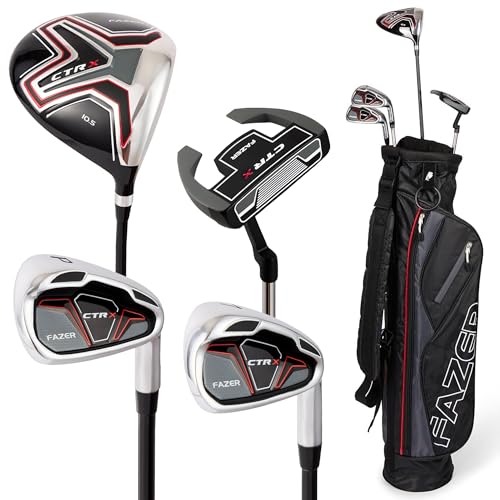
Fazer CTRX Starter Set
- Just the clubs a beginner needs
- Light, compact carry bag
- The lowest-commitment way to start
Price on Amazon
£149.00
Callaway Strata 11-Piece Women's: best ladies set
Verdict: the women's counterpart to our top overall pick, built with lighter graphite shafts and women's-length clubs.
The Strata women's 11-piece mirrors the men's set that tops this guide, tuned for women golfers with lighter, more flexible graphite shafts and clubs cut to a women's length. You get a forgiving driver, a fairway wood, a hybrid, cavity-back irons, a putter and a bag, all from a name new golfers can trust. For a woman starting out, this is the safe, well-specified choice.
- Pros: trusted Callaway name, women's-specific length and flex, complete with bag, very forgiving.
- Cons: right-hand only in this listing, priced above budget women's sets.

Callaway Strata 11-Piece Women's
- Women's-length clubs and lighter shafts
- Forgiving driver, hybrid and irons
- Trusted Callaway build, bag included
Price on Amazon
£320.27
MacGregor DCT4000 13-Piece: best for improvers
Verdict: a fuller set for the beginner who has caught the bug and wants more clubs to grow into.
Once you are playing regularly, an extra club or two starts to matter. The MacGregor DCT4000 gives you a 13-piece line-up with a graphite and steel mix, so you get lighter woods and steadier irons, plus a bag with the pockets a regular player actually uses. MacGregor is a long-standing golf name, and this set has enough spread to see an improver through their first couple of seasons.
- Pros: fuller 13-piece line-up, graphite and steel mix, established golf brand, room to grow.
- Cons: more club than a total beginner needs, heavier bag than a starter kit.
MacGregor DCT4000 13-Piece
- Fuller 13-piece set to grow into
- Graphite woods, steel irons mix
- Long-standing MacGregor golf brand
Price on Amazon
£249.99
What we would skip
A few things to watch when you shop for a first set:
- No-name sets with fake RRPs. An unbranded set listed at "£499.99, now £129.99" is almost always worth its real £129. Judge on the actual price and the volume of genuine reviews, not the imaginary saving.
- Expensive single clubs bought off the shelf. A premium driver or a set of players' irons bought unfitted, before your swing settles, is money in the wrong place. Start with a complete set and fit later.
- Second-hand sets sized for someone else. A bargain used set built for a much taller or shorter player will fight you on every shot. Length and lie matter more than the badge on the head.
- Junior or extra-cheap toy sets for adults. Sub-£70 "adult" sets often use flimsy shafts and light heads that hold your game back. The starter picks here sit at the sensible floor for clubs worth owning.
Frequently asked questions
How many clubs does a beginner actually need?
Far fewer than the maximum of fourteen. A driver, a fairway wood or hybrid, irons from around a 6-iron to a pitching wedge, a sand wedge and a putter cover every shot on the course. A complete beginner set gives you exactly this line-up in a matched flex, which is why it is the smart first buy.
Should I buy a complete set or clubs individually?
Buy a complete set. It arrives matched in flex, length and design, gives you every club you need for one sensible price, and removes decisions you are not ready to make. Building a bag club by club is how experienced golfers fine-tune, not how beginners should start. Upgrade individual clubs later, once your swing settles.
Do beginners need a custom club fitting?
Not for a first set. A well-chosen complete set in a standard flex is close enough while your swing is still changing, and far better value. Book a proper fitting later, once your motion is repeatable and you are ready to invest in individual clubs matched precisely to your swing, length and lie.
Graphite or steel shafts for a beginner?
Graphite for most beginners, and nearly all women and junior golfers, because it is lighter and easier to swing fast, which helps get the ball airborne. Steel is heavier and slightly more consistent for stronger, faster swingers. Many beginner sets sensibly pair graphite woods with steel irons to give you both benefits.
How much should a beginner spend on a first golf set?
A reliable complete set runs from around a starter-kit price up to the big-brand sets, with plenty of good options in between. Spend enough to get forgiving, matched clubs and a decent bag, then put the rest towards lessons and range time. Below the sensible floor, shaft and head quality drop off sharply.
Is a women's set just a men's set in different colours?
No. A proper women's set uses lighter, more flexible graphite shafts and clubs cut to a shorter, women's length, which suits most women's swing speeds and heights far better. Buying a men's set and simply hoping to adjust it means fighting the length and flex on every shot, so choose a set built for the player.
Ready to choose?
For most beginners the Callaway Strata 12-piece is the safe, forgiving, do-everything pick, with the women's 11-piece its equal for women golfers. Choose the SKYMAX Precise M5 if value decides it, the Fazer CTRX starter kit for the lowest-commitment start, the Wilson Ultra HL if you want a recognised brand and a better bag, and the MacGregor DCT4000 if you are already improving and want more clubs to grow into. When you outgrow your first set and want fitted upgrades, browse the Fayrway golf package sets range to see what our pros are stocking.


